Check out a new blog from another encaustic artist, Zane Vredenburg - Emerging Encaustic Artists.
Zane's goal "is to unite a handfull of passionate emerging encaustic artists so that we may encourage and spur one another on to do great things in the art community, raise awareness of the artform and critique each others work."
He does some really great work, too. Check it out.
Saturday, July 22, 2006


Thursday, July 20, 2006
Writing an Artist's Resume
Being an artist means not only making your art but of course promoting your art. But some would argue that you’re really promoting yourself. Regardless, you need to have a good resume.
Edward Winkleman’s blog recently had a great post about resumes/bios with some really valuable information (be sure to read the comments, too). I’ll just add to it by telling you how I deal with my resume.
I created a Word document titled, “current resume,” that I update frequently. This resume includes everything. I probably wouldn’t show this resume to anyone, but it’s nice to have it all documented in case it’s needed someday. I can edit this all inclusive resume and create an alternate resume for any given situation – applying for a teaching position, submitting a proposal to a gallery, applying for a job, etc.
The all inclusive resume is divided into categories and formatted appropriately. The categories include:
Name and contact information (I put this in the header and footer so it shows up on each page)
Forthcoming Exhibitions
Exhibitions (separated by year and then into categories - solo, juried, and group)
Publications (in which I’m mentioned or my work is reviewed)
Collections (public and private)
Teaching Experience
Lectures
Education
Employment
Related Experience (volunteer positions, committees, boards, serving as a juror, etc.)
Awards
I edit down this information to create a resume to send to a gallery.
In the gallery resume, I will include:
Name and Contact Information
Forthcoming Solo Exhibitions
Venue, Location, Date
Example:
Shelbyville Community College, Shelbyville, Missouri, 2007
Selected Exhibitions
I edit the exhibitions and title it, “Selected Exhibitions.” I don’t usually include open shows or member shows, as they aren’t all that impressive (everybody usually gets in, so it’s not considered prestigious). There’s a local exhibition that I enter frequently, so I won’t usually list that unless there was a particularly well-known juror or I won an award in the show. And I do usually include the juror. Some are more well-known than others, but I think it’s good to be consistent (if you list one, you should list them all).
Example:
2005
Solo
"Freezing," Springfield Center for the Arts, Springfield, ME
Group
"Big Time Invitational," The Palomino Gallery, Arlington, CA
"Super Cool Art Exhibition," Johnstown University, Johnstown, TX
Juried
"Simple Things 2005," Sprightly Art Center, Baltimore, OK
(Juror: Stacy Smith, Executive Director, Eagle Mountain Art Center, Chicago, IL)
Public Collections
Private Collections
Publications
Use a consistent, standard formatting method (such as MLA or APA).
Example:
Johnson, John. "Paintings fill art center with life." The Springfield Times 15 Oct. 2005: 7.
Education
Example:
MFA, Studio Painting - Springfield University, Springfield, TX, 2005
Minor: Art History
This gallery resume focuses on exhibitions, collections, and education. If I were to apply for a teaching job, I would probably have a much longer resume, as more and varied activity is important for that type of position.
I don’t usually include a bio unless it is requested. I do have a short bio that I wrote myself, but I’m considering having a writer friend do a more extensive one for me.
Here are a few resources for writing an artist’s bio (some music and dance-related, but still relevant):
Durable Goods
Music Biz Academy
And some resources for resumes:
The Artist's Trust
NYFA Interactive
Edward Winkleman’s blog recently had a great post about resumes/bios with some really valuable information (be sure to read the comments, too). I’ll just add to it by telling you how I deal with my resume.
I created a Word document titled, “current resume,” that I update frequently. This resume includes everything. I probably wouldn’t show this resume to anyone, but it’s nice to have it all documented in case it’s needed someday. I can edit this all inclusive resume and create an alternate resume for any given situation – applying for a teaching position, submitting a proposal to a gallery, applying for a job, etc.
The all inclusive resume is divided into categories and formatted appropriately. The categories include:
Name and contact information (I put this in the header and footer so it shows up on each page)
Forthcoming Exhibitions
Exhibitions (separated by year and then into categories - solo, juried, and group)
Publications (in which I’m mentioned or my work is reviewed)
Collections (public and private)
Teaching Experience
Lectures
Education
Employment
Related Experience (volunteer positions, committees, boards, serving as a juror, etc.)
Awards
I edit down this information to create a resume to send to a gallery.
In the gallery resume, I will include:
Name and Contact Information
Forthcoming Solo Exhibitions
Venue, Location, Date
Example:
Shelbyville Community College, Shelbyville, Missouri, 2007
Selected Exhibitions
I edit the exhibitions and title it, “Selected Exhibitions.” I don’t usually include open shows or member shows, as they aren’t all that impressive (everybody usually gets in, so it’s not considered prestigious). There’s a local exhibition that I enter frequently, so I won’t usually list that unless there was a particularly well-known juror or I won an award in the show. And I do usually include the juror. Some are more well-known than others, but I think it’s good to be consistent (if you list one, you should list them all).
Example:
2005
Solo
"Freezing," Springfield Center for the Arts, Springfield, ME
Group
"Big Time Invitational," The Palomino Gallery, Arlington, CA
"Super Cool Art Exhibition," Johnstown University, Johnstown, TX
Juried
"Simple Things 2005," Sprightly Art Center, Baltimore, OK
(Juror: Stacy Smith, Executive Director, Eagle Mountain Art Center, Chicago, IL)
Public Collections
Private Collections
Publications
Use a consistent, standard formatting method (such as MLA or APA).
Example:
Johnson, John. "Paintings fill art center with life." The Springfield Times 15 Oct. 2005: 7.
Education
Example:
MFA, Studio Painting - Springfield University, Springfield, TX, 2005
Minor: Art History
This gallery resume focuses on exhibitions, collections, and education. If I were to apply for a teaching job, I would probably have a much longer resume, as more and varied activity is important for that type of position.
I don’t usually include a bio unless it is requested. I do have a short bio that I wrote myself, but I’m considering having a writer friend do a more extensive one for me.
Here are a few resources for writing an artist’s bio (some music and dance-related, but still relevant):
Durable Goods
Music Biz Academy
And some resources for resumes:
The Artist's Trust
NYFA Interactive
Tuesday, July 18, 2006
What works
I wanted to talk a little about what seems to be working for me so far.
As I mentioned in previous posts, I created a brochure that features my artwork. I went through the Art In America gallery guide issue and found the galleries that I liked. I've gotten fairly good response from those mailings. I mail a cover letter and my brochure to the gallery. If they're interested, they will contact me and ask for more information. Thanks to that strategy, I have work in one gallery, will be in a group show in another this fall, and I'm talking with two other galleries about possible representation.
Another way that I've gotten gallery interest is just by being in shows. One gallery owner saw my work in a group show and contacted me. I was also contacted recently by a consultant who saw my work in another show (although I'm still trying to figure out if they really want to represent me or if they're just trying to sell me something...).
I also donated a piece to an art auction a few months ago. I have a possible gallery lead due to a contact that I made through the auction.
So I guess the answer is to just get your work out there - the more people see your name and your work, the more likely it is that someone will want to either buy your work, represent you in their gallery, or invite you to be in a show.
I got a great fortune cookie fortune a few years ago that I think applies here: The harder you work, the luckier you get.
So what has worked for you?
As I mentioned in previous posts, I created a brochure that features my artwork. I went through the Art In America gallery guide issue and found the galleries that I liked. I've gotten fairly good response from those mailings. I mail a cover letter and my brochure to the gallery. If they're interested, they will contact me and ask for more information. Thanks to that strategy, I have work in one gallery, will be in a group show in another this fall, and I'm talking with two other galleries about possible representation.
Another way that I've gotten gallery interest is just by being in shows. One gallery owner saw my work in a group show and contacted me. I was also contacted recently by a consultant who saw my work in another show (although I'm still trying to figure out if they really want to represent me or if they're just trying to sell me something...).
I also donated a piece to an art auction a few months ago. I have a possible gallery lead due to a contact that I made through the auction.
So I guess the answer is to just get your work out there - the more people see your name and your work, the more likely it is that someone will want to either buy your work, represent you in their gallery, or invite you to be in a show.
I got a great fortune cookie fortune a few years ago that I think applies here: The harder you work, the luckier you get.
So what has worked for you?
Friday, July 14, 2006
“Professional Practices” classes
In my grad school, the MFA students were required to take a professional practices class. It was technically a photography class, titled “Portfolio Photography,” but it was really professional practices, with a strong emphasis on photography. The class was intended for students who were about to graduate and who were going to apply for teaching jobs or send packets to galleries. Some undergrads would take the class to work on their application packets for grad school.
I think more schools are incorporating this type of class into the studio art curriculum. It’s important for art students to have at least some idea of how to promote themselves when they get out in the “real world.”
My painting professors would include some of this real world advice every now and then, too, by requiring reading (such as Taking the Leap) and discussions. We would often watch art-related videos during our class lunch breaks. I remember one in particular that was about the business of art (I think it was one of those Art City videos).
Someone in the video was talking about how he tells his art students that they should just drop out of school, take the $40,000 they would have spent on school, and spend $1000 each on 40 parties. His point was that if you want to make it in the art world, the MFA isn’t important, but who you know is.
Depressing, no?
Anyway, I wanted to talk about the class I took and what I learned.
Photographing Artwork
Since it was a photography class, we spent some time on basic photography, how a camera works, lighting, developing slides, etc. How to use a light meter and set up lights in the studio to shoot 2-D and 3-D work.
20 slides of 2-D work shot in the studio (including artwork shot from books), 20 slides of 3-D work shot in the studio, and 20 slides of 3-D sculpture shot outdoors.
Self portraits (for promotional purposes).
Artist’s Statement
Elements of artist’s statements, writing exercises, and submit examples of good statements from other artists.
Resume or Curriculum Vitae
What to include, formatting, editing, etc.
Presentation Techniques
How to work a slide projector. How to give a successful slide presentation. Attend and review artist’s lectures.
Power Point
How to scan in slides, adjust them in Photoshop, and import them into a PowerPoint presentation along with resume and artist’s statement.
There were two final projects:
1. Create an attractively designed packet to promote yourself that includes 20 slides, resume, artist’s statement, self portrait, printed image of one piece of artwork, and CD with PowerPoint presentation (also to include 20 images, artist’s statement, and resume).
2. Present a 20-minute slide lecture on your work, using no more than 40 slides.
The class was very beneficial. I used much of what I learned to create my proposal packets that I sent to art centers and galleries. The practice giving presentations was also very valuable.
Have you taken a similar class? What do you think of these types of classes? Should they be required in university art programs?
I think more schools are incorporating this type of class into the studio art curriculum. It’s important for art students to have at least some idea of how to promote themselves when they get out in the “real world.”
My painting professors would include some of this real world advice every now and then, too, by requiring reading (such as Taking the Leap) and discussions. We would often watch art-related videos during our class lunch breaks. I remember one in particular that was about the business of art (I think it was one of those Art City videos).
Someone in the video was talking about how he tells his art students that they should just drop out of school, take the $40,000 they would have spent on school, and spend $1000 each on 40 parties. His point was that if you want to make it in the art world, the MFA isn’t important, but who you know is.
Depressing, no?
Anyway, I wanted to talk about the class I took and what I learned.
Photographing Artwork
Since it was a photography class, we spent some time on basic photography, how a camera works, lighting, developing slides, etc. How to use a light meter and set up lights in the studio to shoot 2-D and 3-D work.
20 slides of 2-D work shot in the studio (including artwork shot from books), 20 slides of 3-D work shot in the studio, and 20 slides of 3-D sculpture shot outdoors.
Self portraits (for promotional purposes).
Artist’s Statement
Elements of artist’s statements, writing exercises, and submit examples of good statements from other artists.
Resume or Curriculum Vitae
What to include, formatting, editing, etc.
Presentation Techniques
How to work a slide projector. How to give a successful slide presentation. Attend and review artist’s lectures.
Power Point
How to scan in slides, adjust them in Photoshop, and import them into a PowerPoint presentation along with resume and artist’s statement.
There were two final projects:
1. Create an attractively designed packet to promote yourself that includes 20 slides, resume, artist’s statement, self portrait, printed image of one piece of artwork, and CD with PowerPoint presentation (also to include 20 images, artist’s statement, and resume).
2. Present a 20-minute slide lecture on your work, using no more than 40 slides.
The class was very beneficial. I used much of what I learned to create my proposal packets that I sent to art centers and galleries. The practice giving presentations was also very valuable.
Have you taken a similar class? What do you think of these types of classes? Should they be required in university art programs?
Tuesday, July 11, 2006
Pricing
I think I get attached to my work and sometimes don't want to let certain pieces go. But the rest of the time, if someone seems like they really like a piece, I have a hard time not just giving it to them. That's not a good way to make a living as an artist, though, is it?
I've had some issues with pricing recently. I won't bore you with the details, but the difficulties have helped me see the wisdom of what you always hear about pricing: be consistent.
Deciding on a price
Pricing your work is tough, especially when you're just starting out. Maybe you're having a show in a student gallery, exhibiting a piece in a local art group's show, or entering regional or national juried shows. If your work is available for sale, you will be asked to include pricing information.
My best advice is to ask around - how are artist's with similar work pricing their work? Then you have to take into account your own "status." Are you just starting out? Have you been painting (or whatever it is that you're doing) for 20 years? If you've been doing watercolor for a year and another artist has been doing it for 25 years, then they will most likely be able to command a higher price for their work.
Then you also have to consider your materials. If you use something rare or expensive, then take that into account when pricing. Framing is another issue - if you've spent a lot on the frame, be sure to include that in the price.
Time is another factor. Some people say not to consider time, but if your work is very time-consuming, you could consider it.
I think most artists start out by figuring pricing by size. Obviously larger pieces usually require more time and more materials, so it's understandable to charge more for them. If it works for you, you could determine a formula to simplify pricing. For example, you could determine a price - say $1 per square inch. You just figure an initial price and then do the math for each subsequent piece...
If you're going to show work in a gallery for the first time (and you haven't already established pricing for your work), I would suggest working with the gallery director to determine the best pricing. He or she will know what collectors will pay for your type of work in their market.
Then, when you've established that pricing, stick with it. This is where the "be consistent" thing comes into play. Your prices should be the same in all galleries and shows and even your studio. What if someone from your town purchased a $1000 painting of yours and then travels to another city and happens to see a similar painting in a gallery for $600? This would annoy, confuse, and possibly anger them.
You need to price work that you sell out of your studio consistently, too. It's common for people to expect an artist to sell her work for less through her studio. The advantage to the artist is that she doesn't have to give the gallery their percentage. This is true, but it will also ruin her reputation with gallery owners. And whatever you say about the inequities in the gallery system and the unfairness of the art world, that's the system that's in place right now, so if you want to work within it, then you have to follow the rules.
Then, as you sell more work and become more known, you can gradually increase your prices.
Here's a good article in Artist's Register about this topic.
Another take, this time from About.com.
And yet another, reprinted from ARTnews.
How do you price your work?
I've had some issues with pricing recently. I won't bore you with the details, but the difficulties have helped me see the wisdom of what you always hear about pricing: be consistent.
Deciding on a price
Pricing your work is tough, especially when you're just starting out. Maybe you're having a show in a student gallery, exhibiting a piece in a local art group's show, or entering regional or national juried shows. If your work is available for sale, you will be asked to include pricing information.
My best advice is to ask around - how are artist's with similar work pricing their work? Then you have to take into account your own "status." Are you just starting out? Have you been painting (or whatever it is that you're doing) for 20 years? If you've been doing watercolor for a year and another artist has been doing it for 25 years, then they will most likely be able to command a higher price for their work.
Then you also have to consider your materials. If you use something rare or expensive, then take that into account when pricing. Framing is another issue - if you've spent a lot on the frame, be sure to include that in the price.
Time is another factor. Some people say not to consider time, but if your work is very time-consuming, you could consider it.
I think most artists start out by figuring pricing by size. Obviously larger pieces usually require more time and more materials, so it's understandable to charge more for them. If it works for you, you could determine a formula to simplify pricing. For example, you could determine a price - say $1 per square inch. You just figure an initial price and then do the math for each subsequent piece...
If you're going to show work in a gallery for the first time (and you haven't already established pricing for your work), I would suggest working with the gallery director to determine the best pricing. He or she will know what collectors will pay for your type of work in their market.
Then, when you've established that pricing, stick with it. This is where the "be consistent" thing comes into play. Your prices should be the same in all galleries and shows and even your studio. What if someone from your town purchased a $1000 painting of yours and then travels to another city and happens to see a similar painting in a gallery for $600? This would annoy, confuse, and possibly anger them.
You need to price work that you sell out of your studio consistently, too. It's common for people to expect an artist to sell her work for less through her studio. The advantage to the artist is that she doesn't have to give the gallery their percentage. This is true, but it will also ruin her reputation with gallery owners. And whatever you say about the inequities in the gallery system and the unfairness of the art world, that's the system that's in place right now, so if you want to work within it, then you have to follow the rules.
Then, as you sell more work and become more known, you can gradually increase your prices.
Here's a good article in Artist's Register about this topic.
Another take, this time from About.com.
And yet another, reprinted from ARTnews.
How do you price your work?
Thursday, July 06, 2006
More Resources
I've come across a few more good resources for marketing your artwork, effective business practices, etc.
About.com has a good article about getting your work into a gallery.
Here's another similar article from an alternative art magazine called Picklebird.
The Artist's Register also has their own take on it.
The New York Foundation for the Arts has some really great business articles.
Enjoy!
About.com has a good article about getting your work into a gallery.
Here's another similar article from an alternative art magazine called Picklebird.
The Artist's Register also has their own take on it.
The New York Foundation for the Arts has some really great business articles.
Enjoy!
Wednesday, June 28, 2006
Career Options - Museums and Galleries
I went off on a tangent about consultants yesterday and forgot that I was supposed to talk about career options!
OK, let's talk about those career options. As I stated earlier, when I began my MFA program, I thought that the only viable career option was to teach on the college level. But I discovered that museum and gallery careers are also available for people with studio MFAs.
Some schools offer classes or degree programs in museum studies. If you're serious about museum work, then museum studies or art history are definitely the way to go. But studio art is also a good career path, as long as you also have some experience that they're looking for...
Curators usually require art history, but often registrar and education positions will only require an MFA. A registrar is a person who sort of organizes and takes care of the artwork in a museum. When artwork is donated or purchased, they will document the condition of the artwork and enter the information into a database. A registrar will work with curators and preparators, deal with insurance, loan agreements, and shipping.
I spoke with a registrar that works at a major museum in the area and she said that she often has to travel with the artwork. If a really big expensive piece is shipped somewhere, she will ride in the truck with it. Well, not IN the truck, but in the cab with the truck driver.
Museum education positions will sometimes require a background in education, but not always. Sometimes they will want someone with museum or gallery experience along with an MFA.
How do I get experience?
The best way to get experience is to volunteer. Some museums and galleries have paid internships, but most of the time the positions will be unpaid. The unpaid positions at major museums can be competitive and prestigious. But a smaller museum, local art gallery, or community art center will most likely be excited to have you as a volunteer. Just be willing to work and you'll learn a lot.
I got a lot of gallery experience while I was in grad school. I worked as a grad assistant in the university art gallery. I worked with another student, unpacking and packing artwork, arranging shipping, buying supplies, installing artwork, patching walls, organizing receptions, and marketing shows.
My university also has a student gallery in the student union that is completely run by students. I volunteered at the gallery director for a year and a half. The students were responsible for installing, patching, marketing, and receptions. Many of them had never had their own shows, so to help them, I put together a packet of information on hanging artwork, writing press releases, reception checklists, and other tips.
I also help the local art group with their shows. I've volunteered as the exhibition chairperson on several shows. This usually involves a LOT of organizational and delegation skills.
One summer I volunteered as an intern at a contemporary art center. I helped out with research, marketing, and exhibit installation.
So if you try, it's pretty easy to get experience in museums and galleries. The big trick, though, is to network. The jobs are very competitive and it helps to know people, talk to people, and ask lots of questions!
OK, let's talk about those career options. As I stated earlier, when I began my MFA program, I thought that the only viable career option was to teach on the college level. But I discovered that museum and gallery careers are also available for people with studio MFAs.
Some schools offer classes or degree programs in museum studies. If you're serious about museum work, then museum studies or art history are definitely the way to go. But studio art is also a good career path, as long as you also have some experience that they're looking for...
Curators usually require art history, but often registrar and education positions will only require an MFA. A registrar is a person who sort of organizes and takes care of the artwork in a museum. When artwork is donated or purchased, they will document the condition of the artwork and enter the information into a database. A registrar will work with curators and preparators, deal with insurance, loan agreements, and shipping.
I spoke with a registrar that works at a major museum in the area and she said that she often has to travel with the artwork. If a really big expensive piece is shipped somewhere, she will ride in the truck with it. Well, not IN the truck, but in the cab with the truck driver.
Museum education positions will sometimes require a background in education, but not always. Sometimes they will want someone with museum or gallery experience along with an MFA.
How do I get experience?
The best way to get experience is to volunteer. Some museums and galleries have paid internships, but most of the time the positions will be unpaid. The unpaid positions at major museums can be competitive and prestigious. But a smaller museum, local art gallery, or community art center will most likely be excited to have you as a volunteer. Just be willing to work and you'll learn a lot.
I got a lot of gallery experience while I was in grad school. I worked as a grad assistant in the university art gallery. I worked with another student, unpacking and packing artwork, arranging shipping, buying supplies, installing artwork, patching walls, organizing receptions, and marketing shows.
My university also has a student gallery in the student union that is completely run by students. I volunteered at the gallery director for a year and a half. The students were responsible for installing, patching, marketing, and receptions. Many of them had never had their own shows, so to help them, I put together a packet of information on hanging artwork, writing press releases, reception checklists, and other tips.
I also help the local art group with their shows. I've volunteered as the exhibition chairperson on several shows. This usually involves a LOT of organizational and delegation skills.
One summer I volunteered as an intern at a contemporary art center. I helped out with research, marketing, and exhibit installation.
So if you try, it's pretty easy to get experience in museums and galleries. The big trick, though, is to network. The jobs are very competitive and it helps to know people, talk to people, and ask lots of questions!
Tuesday, June 27, 2006
Consultants
I have to admit that I don't really know a lot about art consultants. From what I've read, they usually represent a group of artists and will work to sell the artists' work to museums, corporations and private collectors.
I am represented by a consultant, although I don't know if that's what she considers herself. She calls her business a gallery but she doesn't have a physical gallery space. She created a website for the gallery where she features several images from each artist. She contacts collectors and interior designers and if a client is interested in a piece, she will contact the artist and arrange to pick up the artwork. She will then take the artwork to the client's home or business so they can see if it matches their couch. Well, hopefully they make more sophisticated aesthetic judgements...
If she sells the piece, she keeps a percentage, much the same way that a gallery owner would.
I assume that consultants work in a similar way.
So this week I've begun sending packets to some consultants. I identified a few in the Art in America gallery guide that I've mentioned several times. I looked at their websites to see if they had submission guidelines and I don't think any of them did. So I just made sure I had the current address and tried to find a contact person.
I put together a PowerPoint presentation that features about 20 paintings, about 3 installation shots, my artist's statement, and my resume. I also included a version saved as a PowerPoint slide show, a version saved as a pdf document, and a folder that includes only the jpg images. Hopefully this will cover all the bases - accommodate all programs and platforms. I burned all of this to a CD.
I bought some 6" x 9" envelopes and made some mailing labels that match my letterhead. I included a cover letter, the CD and my brochure. I made a little sleeve for the CD out of the same letterhead paper.
I'll be sending out 14 total. Most of them are in New York but surprisingly about 3 or 4 were in Houston. I'll let you know what happens.
I am represented by a consultant, although I don't know if that's what she considers herself. She calls her business a gallery but she doesn't have a physical gallery space. She created a website for the gallery where she features several images from each artist. She contacts collectors and interior designers and if a client is interested in a piece, she will contact the artist and arrange to pick up the artwork. She will then take the artwork to the client's home or business so they can see if it matches their couch. Well, hopefully they make more sophisticated aesthetic judgements...
If she sells the piece, she keeps a percentage, much the same way that a gallery owner would.
I assume that consultants work in a similar way.
So this week I've begun sending packets to some consultants. I identified a few in the Art in America gallery guide that I've mentioned several times. I looked at their websites to see if they had submission guidelines and I don't think any of them did. So I just made sure I had the current address and tried to find a contact person.
I put together a PowerPoint presentation that features about 20 paintings, about 3 installation shots, my artist's statement, and my resume. I also included a version saved as a PowerPoint slide show, a version saved as a pdf document, and a folder that includes only the jpg images. Hopefully this will cover all the bases - accommodate all programs and platforms. I burned all of this to a CD.
I bought some 6" x 9" envelopes and made some mailing labels that match my letterhead. I included a cover letter, the CD and my brochure. I made a little sleeve for the CD out of the same letterhead paper.
I'll be sending out 14 total. Most of them are in New York but surprisingly about 3 or 4 were in Houston. I'll let you know what happens.
Saturday, June 24, 2006
Teaching
Well, Jenna, and the mysterious "Anonymous," have asked what I didn't like about teaching...
When I decided to go to grad school, I knew that teaching was pretty much the only reason that people get MFAs. Not that I don't know plenty of people with MFAs who don't teach. It's just the standard career track - BFA, MFA, teaching position. And then you're expected to produce work and exhibit while you're teaching. And I do think that being in the creative/academic environment would be beneficial to keep one in touch with the art world.
So I went to grad school and kind of secretly hoped that I wouldn't have to teach. But I was eventually asked to teach a basic drawing class. It turned out to be two sections of basic drawing during one semester.
Now, I knew that teaching would be hard. Preparing lessons, finding still life items, doing demos and lectures - it all takes a lot of time and energy. And it turns out that all of that was even a lot harder than I had anticipated.
But, honestly, what turned me off to teaching (at least in the university environment) was that the students really didn't want to be there. I guess I had an unrealistic expectation that college students are adults and they wouldn't be there unless they wanted to be. Basic drawing was made up mostly of students in their first semester. And at least half of them really didn't care. They would do the absolute minimum (if that much), make lots of excuses when they couldn't, and expect a good grade.
I also didn't feel qualified to teach the material. I had been able to draw at one time, but it's definitely a skill that you have to practice. So I really felt like a fraud. Someone pointed out that I knew more than they did, and that was really the only way I made it through. I felt like I was just a step ahead of them.
I know when I take a class, the enthusiasm level of the instructor makes a big difference. If someone is really passionate about the subject and really loves to teach, then you'll probably have a good experience. I feel like if I can't be that, then the students are being short-changed.
That said, I do love to teach encaustic workshops. And I would love to teach bookmaking. I'm excited and passionate about those two things, and I feel comfortable with the material.
The encaustic workshops are a completely different audience. They're excited to be there and really want to learn, so it makes it really fun for me to teach.
Perhaps my perspective about teaching would be a lot different if I had felt that way about drawing.
So I guess I should have said that I decided I didn't want to teach art in a university. I enjoy teaching the workshops and I'll probably continue those as long as I can find people who want to take them.
There are artists who make a pretty good living teaching workshops along with selling their artwork. Some of them even develop a following. So workshop teaching is definitely a possible teaching venue for artists.
I'll talk more next time about some other career options.
When I decided to go to grad school, I knew that teaching was pretty much the only reason that people get MFAs. Not that I don't know plenty of people with MFAs who don't teach. It's just the standard career track - BFA, MFA, teaching position. And then you're expected to produce work and exhibit while you're teaching. And I do think that being in the creative/academic environment would be beneficial to keep one in touch with the art world.
So I went to grad school and kind of secretly hoped that I wouldn't have to teach. But I was eventually asked to teach a basic drawing class. It turned out to be two sections of basic drawing during one semester.
Now, I knew that teaching would be hard. Preparing lessons, finding still life items, doing demos and lectures - it all takes a lot of time and energy. And it turns out that all of that was even a lot harder than I had anticipated.
But, honestly, what turned me off to teaching (at least in the university environment) was that the students really didn't want to be there. I guess I had an unrealistic expectation that college students are adults and they wouldn't be there unless they wanted to be. Basic drawing was made up mostly of students in their first semester. And at least half of them really didn't care. They would do the absolute minimum (if that much), make lots of excuses when they couldn't, and expect a good grade.
I also didn't feel qualified to teach the material. I had been able to draw at one time, but it's definitely a skill that you have to practice. So I really felt like a fraud. Someone pointed out that I knew more than they did, and that was really the only way I made it through. I felt like I was just a step ahead of them.
I know when I take a class, the enthusiasm level of the instructor makes a big difference. If someone is really passionate about the subject and really loves to teach, then you'll probably have a good experience. I feel like if I can't be that, then the students are being short-changed.
That said, I do love to teach encaustic workshops. And I would love to teach bookmaking. I'm excited and passionate about those two things, and I feel comfortable with the material.
The encaustic workshops are a completely different audience. They're excited to be there and really want to learn, so it makes it really fun for me to teach.
Perhaps my perspective about teaching would be a lot different if I had felt that way about drawing.
So I guess I should have said that I decided I didn't want to teach art in a university. I enjoy teaching the workshops and I'll probably continue those as long as I can find people who want to take them.
There are artists who make a pretty good living teaching workshops along with selling their artwork. Some of them even develop a following. So workshop teaching is definitely a possible teaching venue for artists.
I'll talk more next time about some other career options.
Thursday, June 22, 2006
Brochure
When I graduated, a friend gave me a copy of How to Survive and Prosper as an Artist by Caroll Michels. I read it from cover to cover and still reference it often. She goes into detail about a lot of really important topics - starting a career, pricing your work, creating presentation packets, dealing with galleries, working another job to support your art, etc.
One of the main things that I got out of this book was the way she suggests approaching galleries. Traditionally, you would visit a gallery, talk to the owner or director, and then send them slides of your work later. They would review your slides and then contact you to either say, "No, thanks," or to get more information and possibly represent you.
Michels' approach is a bit different. She suggests creating a brochure that includes information about you and some images of your work. You send this brochure, along with a cover letter, to galleries that you think your work fits into.
I was attracted to this approach because I have a background in graphic design and creating a brochure myself was fairly easy. A brochure is small and easy to mail. The main reason, though is that slides are expensive to duplicate and often galleries will hold your information for months before reviewing and returning it. I didn't want my slides to be damaged or lost or buried under a pile on someone's desk for 6 months.
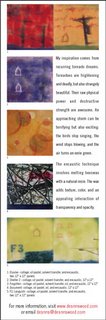
So I created a small brochure. Folded, it measures 3.5" x 3.5". My work is mostly square, so I wanted to carry the square format through to the brochure. I included my name on the front, over a detail from one of my paintings. Inside, I included images of five more paintings, an exceprt from my artist's statement, my email address and website. On the back, I included an exceprt from my resume that includes my education and a few exhibitions.
I had 2,000 copies professionally printed a little over a year ago. In hindsight, I probably should have only done 1,000, but I think they're general enough to last for another year or so.

So what do I do with them? First of all, I give them to practically everyone I meet. But mostly I send them to galleries.
I mentioned in my post on calls for proposals that I use the Art in America museum and gallery guide issue to find university galleries and art centers to which I send proposals. It's also a great resource for finding galleries.
I started at the beginning (they're listed alphabetically by state and city) - I read the description and if it sounds like they exhibit contemporary art, I'll check to see if they have a website. If so, I'll visit the website and look at the work of the artists that the gallery represents. If I can picture my artwork there, I'll then look for any submission guidelines.
Sometimes galleries will post their submission guidelines on their websites. Sometimes they'll say,"We're not taking on any new artists at this time, please don't send us anything." Sometimes they'll have very specific guidelines, "Send 20 slides, resume, and statement. Do not send additional information. Submissions without SASE will be immediately discarded." Seriously. They can get picky.
Follow the guidelines. Galleries get hundreds of submissions and if you don't follow their rules, they won't even consider you.
So I look for galleries that will accept CDs or allow you to email them jpg images of your work or a link to your website.
And if they don't have any guidelines, I'll send them a cover letter and my brochure.
Often I wouldn't hear back, so I started to include a SASE as well. I don't know why, but I'd rather get a rejection letter than not hear from them at all. (I'll rant about rejection letters another time.)
I've gotten a few positive responses from the brochure mailings. I need to count how many I've mailed out and the responses I've gotten back and do some analysis... Anyway, I'm sure there are some old school, traditional gallery types that get my brochure and think, "Why, she's not following the rules!" or "This is stupid." Well, I don't want to deal with those snobby people, anyway, do I?
One of the main things that I got out of this book was the way she suggests approaching galleries. Traditionally, you would visit a gallery, talk to the owner or director, and then send them slides of your work later. They would review your slides and then contact you to either say, "No, thanks," or to get more information and possibly represent you.
Michels' approach is a bit different. She suggests creating a brochure that includes information about you and some images of your work. You send this brochure, along with a cover letter, to galleries that you think your work fits into.
I was attracted to this approach because I have a background in graphic design and creating a brochure myself was fairly easy. A brochure is small and easy to mail. The main reason, though is that slides are expensive to duplicate and often galleries will hold your information for months before reviewing and returning it. I didn't want my slides to be damaged or lost or buried under a pile on someone's desk for 6 months.
So I created a small brochure. Folded, it measures 3.5" x 3.5". My work is mostly square, so I wanted to carry the square format through to the brochure. I included my name on the front, over a detail from one of my paintings. Inside, I included images of five more paintings, an exceprt from my artist's statement, my email address and website. On the back, I included an exceprt from my resume that includes my education and a few exhibitions.

I had 2,000 copies professionally printed a little over a year ago. In hindsight, I probably should have only done 1,000, but I think they're general enough to last for another year or so.

So what do I do with them? First of all, I give them to practically everyone I meet. But mostly I send them to galleries.
I mentioned in my post on calls for proposals that I use the Art in America museum and gallery guide issue to find university galleries and art centers to which I send proposals. It's also a great resource for finding galleries.
I started at the beginning (they're listed alphabetically by state and city) - I read the description and if it sounds like they exhibit contemporary art, I'll check to see if they have a website. If so, I'll visit the website and look at the work of the artists that the gallery represents. If I can picture my artwork there, I'll then look for any submission guidelines.
Sometimes galleries will post their submission guidelines on their websites. Sometimes they'll say,"We're not taking on any new artists at this time, please don't send us anything." Sometimes they'll have very specific guidelines, "Send 20 slides, resume, and statement. Do not send additional information. Submissions without SASE will be immediately discarded." Seriously. They can get picky.
Follow the guidelines. Galleries get hundreds of submissions and if you don't follow their rules, they won't even consider you.
So I look for galleries that will accept CDs or allow you to email them jpg images of your work or a link to your website.
And if they don't have any guidelines, I'll send them a cover letter and my brochure.
Often I wouldn't hear back, so I started to include a SASE as well. I don't know why, but I'd rather get a rejection letter than not hear from them at all. (I'll rant about rejection letters another time.)
I've gotten a few positive responses from the brochure mailings. I need to count how many I've mailed out and the responses I've gotten back and do some analysis... Anyway, I'm sure there are some old school, traditional gallery types that get my brochure and think, "Why, she's not following the rules!" or "This is stupid." Well, I don't want to deal with those snobby people, anyway, do I?
Monday, June 19, 2006
Taking the Leap
Not long after I started grad school, one of my professors suggested Taking the Leap by Cay Lang.
It had a lot of great "how to" information in it - how to approach galleries, organize a show, write a press release, photograph your work, etc.
The thing that I remember most about it, though, was that the author encouraged artists not to compromise. She says that you shouldn't try to find a style or subject matter that will "sell" but that you should create your artwork according to your own vision and then put it out there. Someone will like it. Eventually.
So that's the approach that I've embraced, for good or bad. Art is so subjective. Everybody responds differently, which is what makes it so exciting. So I think that if I put my stuff out there as much as I can, eventually I'll find enough people that like it.
Not that you shouldn't grow and change. Feedback is crucial. You'll get an idea of what people respond to and then you can build on that, incorporating new ideas into your work to keep it fresh.
I see artists that find something that works and it seems like they cling to it and never grow or change or do anything else. Like I'm one to talk - I've been doing tornadoes for 5 years!
It had a lot of great "how to" information in it - how to approach galleries, organize a show, write a press release, photograph your work, etc.
The thing that I remember most about it, though, was that the author encouraged artists not to compromise. She says that you shouldn't try to find a style or subject matter that will "sell" but that you should create your artwork according to your own vision and then put it out there. Someone will like it. Eventually.
So that's the approach that I've embraced, for good or bad. Art is so subjective. Everybody responds differently, which is what makes it so exciting. So I think that if I put my stuff out there as much as I can, eventually I'll find enough people that like it.
Not that you shouldn't grow and change. Feedback is crucial. You'll get an idea of what people respond to and then you can build on that, incorporating new ideas into your work to keep it fresh.
I see artists that find something that works and it seems like they cling to it and never grow or change or do anything else. Like I'm one to talk - I've been doing tornadoes for 5 years!
Wednesday, June 14, 2006
Calls for Proposals
In the previous post, I described how I put together my packet for my exhibition proposals. So how do I find calls for proposals?
By the way, a "call for proposal" is a term used for a listing by a museum, gallery, art center, or art organization that is essentially "calling" or inviting artists to send them proposals for exhibitions. They will usually list pertinent details such as the deadline for the proposal, the location of the venue, requirements (open to all artists or maybe only artists from a specific geographic area), type of artwork they're looking for, time period of the exhibition, size of the venue, the materials that they will consider (slides, CD, etc), if insurance is provided, if there is a commission taken, fees or stipends paid to artists (sometimes they will pay for shipping if you're very lucky), address and contact information. Most do not charge a fee to review proposals but every now and then you'll see one that will (usually $20 or so).
Here's a sample call for proposal:
Deadline July 15, 2006
Community College of Shelbyville is reviewing proposals for solo or group (2 or 3 artists) exhibitions for the 2006-2007 season. Honorarium for lecture/workshop. Open to US artists. 2-D and 3-D work. No sales commission. Insurance. Send 20 labeled slides (or CD), resume, statement, contact info, and SASE to Community College of Shelbyville...
Art Calendar is a great resource for calls for proposals and calls for entries. It's a monthly publication that deals with the business of art, with great articles about photographing your artwork, marketing, and finding inspiration. The last 10 pages or so are listings of awards, conferences and trade shows, fairs and festivals, galleries and nonprofit spaces reviewing portfolios, grants, and juried shows.
The Art Deadlines list is another great resource. It's a monthly email that lists lots of calls for entries and calls for proposals. You can subscribe and receive a comprehensive list or just sign up for the smaller free list.
There's also Art Deadline, which I don't think has a free list...
You can also find a lot of great information on your state's art commission website. The one in Texas is called TCANet. They list lots of opportunities for artists, among other things.
I've also used the annual gallery guide from Art in America. It comes out every summer and it lists hundreds of galleries, museums, and art centers all over the country. It's organized alphabetically by state and then by city. It's fairly comprehensive, but I think the galleries/museums have to submit their information to be included.
I happened to find a great book at my local library called Art Guide Texas by Rebecca S. Cohen. She travelled around Texas and collected information on museums, art centers, and non-profit art exhibition spaces. It had a lot of great information in it. I'm not sure if there are equivalent publications for other states.
When I find a listing for a university gallery or art center that I'm curious about, I will look at their website (if I can find one) and if I'm interested in showing there, I'll look for submission guidelines. If I can't find any on their website, I will email the gallery director and ask if they accept exhibition proposals from artists and if so, do they accept proposals on CD (I personally don't like to send slides and would rather send my images on CD). Most will accept proposals from artists and on CD, but every now and then I'll find one that only deals with slides or only accepts proposals from curators.
Most art centers and university galleries have exhibition committees that meet periodically to review proposals. They could have your proposal for quite a while before you hear from them, so be patient.
Of the 49 proposals that I've sent out starting in February of 2005, I've received 2 "we like your work but we'll get back to you" responses, 18 rejections, and 6 shows. Persistence pays off!
By the way, a "call for proposal" is a term used for a listing by a museum, gallery, art center, or art organization that is essentially "calling" or inviting artists to send them proposals for exhibitions. They will usually list pertinent details such as the deadline for the proposal, the location of the venue, requirements (open to all artists or maybe only artists from a specific geographic area), type of artwork they're looking for, time period of the exhibition, size of the venue, the materials that they will consider (slides, CD, etc), if insurance is provided, if there is a commission taken, fees or stipends paid to artists (sometimes they will pay for shipping if you're very lucky), address and contact information. Most do not charge a fee to review proposals but every now and then you'll see one that will (usually $20 or so).
Here's a sample call for proposal:
Deadline July 15, 2006
Community College of Shelbyville is reviewing proposals for solo or group (2 or 3 artists) exhibitions for the 2006-2007 season. Honorarium for lecture/workshop. Open to US artists. 2-D and 3-D work. No sales commission. Insurance. Send 20 labeled slides (or CD), resume, statement, contact info, and SASE to Community College of Shelbyville...
Art Calendar is a great resource for calls for proposals and calls for entries. It's a monthly publication that deals with the business of art, with great articles about photographing your artwork, marketing, and finding inspiration. The last 10 pages or so are listings of awards, conferences and trade shows, fairs and festivals, galleries and nonprofit spaces reviewing portfolios, grants, and juried shows.
The Art Deadlines list is another great resource. It's a monthly email that lists lots of calls for entries and calls for proposals. You can subscribe and receive a comprehensive list or just sign up for the smaller free list.
There's also Art Deadline, which I don't think has a free list...
You can also find a lot of great information on your state's art commission website. The one in Texas is called TCANet. They list lots of opportunities for artists, among other things.
I've also used the annual gallery guide from Art in America. It comes out every summer and it lists hundreds of galleries, museums, and art centers all over the country. It's organized alphabetically by state and then by city. It's fairly comprehensive, but I think the galleries/museums have to submit their information to be included.
I happened to find a great book at my local library called Art Guide Texas by Rebecca S. Cohen. She travelled around Texas and collected information on museums, art centers, and non-profit art exhibition spaces. It had a lot of great information in it. I'm not sure if there are equivalent publications for other states.
When I find a listing for a university gallery or art center that I'm curious about, I will look at their website (if I can find one) and if I'm interested in showing there, I'll look for submission guidelines. If I can't find any on their website, I will email the gallery director and ask if they accept exhibition proposals from artists and if so, do they accept proposals on CD (I personally don't like to send slides and would rather send my images on CD). Most will accept proposals from artists and on CD, but every now and then I'll find one that only deals with slides or only accepts proposals from curators.
Most art centers and university galleries have exhibition committees that meet periodically to review proposals. They could have your proposal for quite a while before you hear from them, so be patient.
Of the 49 proposals that I've sent out starting in February of 2005, I've received 2 "we like your work but we'll get back to you" responses, 18 rejections, and 6 shows. Persistence pays off!
Tuesday, June 13, 2006
Proposals
My work deals with a definite theme - tornadoes. I've had dreams about tornadoes since I was little and we lived in Kansas. I've never been in one or seen one, but I guess living there during that time made a big impression on me.
When I had my MFA exhibition, one of my professors suggested that I document it and send out proposals to art centers and university galleries all over tornado alley. I think it was a great idea.
Here's what my packet looks like:

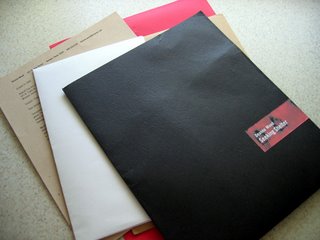
I bought some standard black pocket folders and cut a little slit in the right pocket for my CD. I tuck my little brochure into the business card slit on the left side. In the left pocket, I put copies of press clippings, my resume, and some postcards from shows (the cards that feature images of my work). In the right pocket, I put a sheet that has thumbnail images of what's on the CD (the equivalent of a slide list) and my artist's statement.
I print some nice labels to adhere to the CD and I also print out a little label to put on the front of the folder. I have a coordinating envelope (mine happens to be red) that everything goes into. I usually put the cover letter on top of the folder and put a piece of cardboard behind the folder.
I also include a large SASE for the return of my materials. I used to not include that - it's more expensive to mail it than to just make a new one and I figured they could throw it away if they weren't interested. But some people would send it back anyway at their expense and I felt bad about that. Some gallery submission guidelines indicate that they will throw away anything that they get without an SASE. So I started including one, just in case...
I also print my resume, artist's statement, and the cover letter on the same paper (I use French Speckletone in Kraft). I come from a graphic design background, so packaging is really important to me. I think having a professional, cohesive, well-designed packet will help you stand out in the crowd. I have been warned not to make it look "too designed." Whatever that means. I guess you don't want the packaging to overwhelm the work.
Tomorrow I'll talk more about the process of finding the places to send the proposals to.
When I had my MFA exhibition, one of my professors suggested that I document it and send out proposals to art centers and university galleries all over tornado alley. I think it was a great idea.
Here's what my packet looks like:

I bought some standard black pocket folders and cut a little slit in the right pocket for my CD. I tuck my little brochure into the business card slit on the left side. In the left pocket, I put copies of press clippings, my resume, and some postcards from shows (the cards that feature images of my work). In the right pocket, I put a sheet that has thumbnail images of what's on the CD (the equivalent of a slide list) and my artist's statement.
I print some nice labels to adhere to the CD and I also print out a little label to put on the front of the folder. I have a coordinating envelope (mine happens to be red) that everything goes into. I usually put the cover letter on top of the folder and put a piece of cardboard behind the folder.

I also include a large SASE for the return of my materials. I used to not include that - it's more expensive to mail it than to just make a new one and I figured they could throw it away if they weren't interested. But some people would send it back anyway at their expense and I felt bad about that. Some gallery submission guidelines indicate that they will throw away anything that they get without an SASE. So I started including one, just in case...
I also print my resume, artist's statement, and the cover letter on the same paper (I use French Speckletone in Kraft). I come from a graphic design background, so packaging is really important to me. I think having a professional, cohesive, well-designed packet will help you stand out in the crowd. I have been warned not to make it look "too designed." Whatever that means. I guess you don't want the packaging to overwhelm the work.
Tomorrow I'll talk more about the process of finding the places to send the proposals to.
Where I started...
I guess I'll talk a little about how I started out in my art career. I received a Bachelor of Fine Arts in graphic design. During my last year of school, I worked at a company as a co-op student (an internship that allows you to earn credit). I was lucky that the company hired me to work full time after I graduated.
The company also offered tuition reimbursement. So a couple of years later, I decided to go back to school to get my Master of Arts in graphic design.
I worked for a few more years but was laid off in 2002. I decided to try to get some freelance work and go back to school to work on my Master of Fine Arts in painting. I had taken a painting class and was toying around with the idea of doing the MFA part time. Being laid off gave me the freedom (as scary as it was) to do it full time.
Freelancing didn't really work for me - it takes a lot of time to get clients and (I soon discovered) even more time to get them to pay you. So I dedicated most of my time to school. I'm also a single mom and have a son. Being in school gave me a chance to hang out with him in my spare time.
I didn't really know what I wanted to do with the MFA. I didn't really want to teach, but I knew I wanted to get the degree. I also just really like the academic atmosphere - being able to get feedback, share ideas, and talk with other creative people is really valuable.
Anyway, after teaching a couple of classes, I realized that I really didn't want to teach. :-)
I'll talk more about teaching later...
I volunteered with the local art league and got involved with organizing shows. I also worked as a grad assistant in the university art gallery and volunteered as the director of the student gallery. So I realized that I really liked gallery/museum work (packing, unpacking, hanging artwork, etc.) or doing something that assists artists in some way.
After I graduated, I spent a whole year looking for a museum or gallery job. Problems - they're very competitive and I wanted to stay in the area because of my son.
I worked part time and scraped by as best I could until I got a full time job as a secretary at a local university. It's not such a bad gig, really. Doesn't pay much but has good benefits, five minutes from my house, not a lot of work (low stress), and I don't have to move out of the area. I have a lot of down time so I get to do a lot of my own stuff (like this blog).
So that's where I am now. Later I'll talk more about what I'm doing to promote my artwork.
The company also offered tuition reimbursement. So a couple of years later, I decided to go back to school to get my Master of Arts in graphic design.
I worked for a few more years but was laid off in 2002. I decided to try to get some freelance work and go back to school to work on my Master of Fine Arts in painting. I had taken a painting class and was toying around with the idea of doing the MFA part time. Being laid off gave me the freedom (as scary as it was) to do it full time.
Freelancing didn't really work for me - it takes a lot of time to get clients and (I soon discovered) even more time to get them to pay you. So I dedicated most of my time to school. I'm also a single mom and have a son. Being in school gave me a chance to hang out with him in my spare time.
I didn't really know what I wanted to do with the MFA. I didn't really want to teach, but I knew I wanted to get the degree. I also just really like the academic atmosphere - being able to get feedback, share ideas, and talk with other creative people is really valuable.
Anyway, after teaching a couple of classes, I realized that I really didn't want to teach. :-)
I'll talk more about teaching later...
I volunteered with the local art league and got involved with organizing shows. I also worked as a grad assistant in the university art gallery and volunteered as the director of the student gallery. So I realized that I really liked gallery/museum work (packing, unpacking, hanging artwork, etc.) or doing something that assists artists in some way.
After I graduated, I spent a whole year looking for a museum or gallery job. Problems - they're very competitive and I wanted to stay in the area because of my son.
I worked part time and scraped by as best I could until I got a full time job as a secretary at a local university. It's not such a bad gig, really. Doesn't pay much but has good benefits, five minutes from my house, not a lot of work (low stress), and I don't have to move out of the area. I have a lot of down time so I get to do a lot of my own stuff (like this blog).
So that's where I am now. Later I'll talk more about what I'm doing to promote my artwork.
Sunday, June 11, 2006
Thoughts from an emerging artist
I had an idea today while I was in the shower (where I get my best ideas) - create a blog that would document the trials and tribulations of starting an art career. I have a website that I use to promote my work, a personal blog that I use to communicate with friends, and a MySpace profile that I use to find sexual predators (so far, at least), but I thought a blog dedicated to my career struggles and triumphs might be helpful to others who are in the same boat.
In my initial (very cursory) research, I came across a couple of other people doing something similar:
Emerging Artist Resources
Edward Winkleman
I'm sure I'll find more. I'll post others and go into more detail about them in the future.
I'm hoping to start conversations, show support, and share resources and ideas with other artists. I hope you'll join me!
In my initial (very cursory) research, I came across a couple of other people doing something similar:
Emerging Artist Resources
Edward Winkleman
I'm sure I'll find more. I'll post others and go into more detail about them in the future.
I'm hoping to start conversations, show support, and share resources and ideas with other artists. I hope you'll join me!
Subscribe to:
Posts (Atom)