Today was my first day of "freedom." Friday was the last day at the day job.
I sent off my entry to R&F's Encaustic Works 07. Tonight I'm going to get my entry ready for New American Paintings (this is the year!) and possibly respond to a couple of other calls for proposals.
I started freaking out a little about money today - just minor things like worrying that I don't have enough and wondering where it's going to come from...
I tend to be more pragmatic and cautious, so saying things like, "The universe will provide," seems a little flaky to me. It sounds great until you try to explain it to a parent or an ex-spouse...
Today I also helped out with the installation of the local art group's national juried show (I unpacked the artwork again this year, so I have lots more ranting to do about how not to pack artwork - I even took pictures of some of the worst offenders!).
Tomorrow I'm off to Kansas. I'm spending the night with my brother and his family in Overland Park. I had my work sent there from the last show in Iowa, so I'm going to pick it up there and drive it to Manhattan for installation. The reception is Saturday, April 14th from 4 to 6 pm - if you're in the area, stop by and say hi!
My friend Colleen will hopefully be able to go to the reception, so that'll be fun.
Last night I watched What the Bleep Do We Know? It sounds similar to The Secret. It was about reality and quantum physics and all that. I liked it but I need to watch it again. That stuff just blows my mind...
I get back on Sunday and plan to spend a lot of time in my studio next week. I want to finish up my Waxy Buildup pieces and get started on the next thing. I want to explore the concept of palimpsest - where writing has been erased and written over.
Oh, and I've also curated a show that will be on display in May at Tarrant County College in Arlington, Texas. It's a show of artist's books called Beyond the Scrapbook. More about that later.
Well, I guess I should pack!
Monday, April 09, 2007


Tuesday, April 03, 2007
Rejection Letters, Demystified...
I got a great comment on my most recent post about rejection letters. I had wondered why I was getting so many hits on people searching for "rejection letter." Were they trying to find other rejects with which to commiserate? Were they looking for wording for their own cruel rejection letters?
A gallery employee named Freshie Beth posted this comment:
"Awesome post! I work in an art gallery and I was honestly googling "artist rejection letter" to try and come up with better wording than what I usually send to artists, which I know is short and not very sweet. What can I say - I get two or three submissions a day and I have other things to do than come up with a nice, thoughtful rejection letter for each and every one. Usually the work is so awful, I'm trying to hold back and not be mean (I am blunt by nature). As a gallery director, I can translate those letters for you... When they say they're not currently seeking other artists, they're saying that they don't want to fit you in. If they liked your work and wanted to sell it, they would bring you in unless their gallery really is just a 10' x 10' space. They either don't like your work or it truly isn't a fit with their gallery. Some galleries have very narrow focuses or they just really know what their clients buys and don't want to waste your time or theirs. Our gallery has a variety of subject matter, but it is cohesive and I can tell what "fits" and what doesn't. If we reject someone, it's 95% because the work isn't good enough for our semi-high-end gallery. Out of 50 submission, I might get one that I actually think we could sell. Then, 9 out of 10 of those artists flake out and we never hear from them again. We even offered to have a show for a new artist who we spoke with a few times, then - nothing. Where did he go? The whole process is pretty ridiculous!"
There's a lot to digest there.
She confirms my original hunch that gallery directors really mean that they don't like your work when they say things like, "not a good fit," or "not looking for new artists..."
So I was thinking that it might be funny to, instead of just sending a SASE along with my materials, send a little self-addressed, stamped postcard reminiscent of those notes you sent to the kid you were crushing on in third grade:
 This doesn't give them the option to say any of those things that are open for interpretation. It's either yes or no. Wouldn't you rather know why they don't like your work? Or why they don't think it's right for their gallery?
I was surprised by her statement that 9 out of 10 artists flake out. Are aritsts really that flaky? That makes me sad.
I wonder if her experiences are similar to those of other gallery owners?
A gallery employee named Freshie Beth posted this comment:
"Awesome post! I work in an art gallery and I was honestly googling "artist rejection letter" to try and come up with better wording than what I usually send to artists, which I know is short and not very sweet. What can I say - I get two or three submissions a day and I have other things to do than come up with a nice, thoughtful rejection letter for each and every one. Usually the work is so awful, I'm trying to hold back and not be mean (I am blunt by nature). As a gallery director, I can translate those letters for you... When they say they're not currently seeking other artists, they're saying that they don't want to fit you in. If they liked your work and wanted to sell it, they would bring you in unless their gallery really is just a 10' x 10' space. They either don't like your work or it truly isn't a fit with their gallery. Some galleries have very narrow focuses or they just really know what their clients buys and don't want to waste your time or theirs. Our gallery has a variety of subject matter, but it is cohesive and I can tell what "fits" and what doesn't. If we reject someone, it's 95% because the work isn't good enough for our semi-high-end gallery. Out of 50 submission, I might get one that I actually think we could sell. Then, 9 out of 10 of those artists flake out and we never hear from them again. We even offered to have a show for a new artist who we spoke with a few times, then - nothing. Where did he go? The whole process is pretty ridiculous!"
There's a lot to digest there.
She confirms my original hunch that gallery directors really mean that they don't like your work when they say things like, "not a good fit," or "not looking for new artists..."
So I was thinking that it might be funny to, instead of just sending a SASE along with my materials, send a little self-addressed, stamped postcard reminiscent of those notes you sent to the kid you were crushing on in third grade:
 This doesn't give them the option to say any of those things that are open for interpretation. It's either yes or no. Wouldn't you rather know why they don't like your work? Or why they don't think it's right for their gallery?
I was surprised by her statement that 9 out of 10 artists flake out. Are aritsts really that flaky? That makes me sad.
I wonder if her experiences are similar to those of other gallery owners?
Monday, April 02, 2007
Thanks
I just wanted to thank everyone for their encouragement and support. So many great comments!
This is my last week of the "real" job. It's scary but exciting. Most of the time. I keep having these periods where I think, "What am I doing?" But luckily they pass quickly and I focus on my goal again.
Next week I'm going to travel to Manhattan, Kansas to install my show. I'm looking forward to it.
More written inspiration:
I just finished a little book by Deepak Chopra called Creating Affluence. It's made me want to learn more about meditation.
Along the same lines, I just started reading Train Your Mind, Change Your Brain by Sharon Begley. She talks about Buddhism and neuroscience. Really interesting.
I'm also slowly re-reading The Courage to Create by Rollo May. This is one of those books that I keep around and pick up over and over again...
Not related to art, really, but I also recently read Apartment Therapy. I don't live in an apartment, but I've been reading their blog for a while, and just happened to notice that the library had it, so I grabbed it. I hadn't really paid much attention to the actual "therapy" that they do on the blog, so the book was different than what I had anticipated. But I really liked it. I took on my living room and my bedroom - clearing out the clutter and making them much better spaces. I also started buying myself flowers - such a nice treat!
I deserve it.
This is my last week of the "real" job. It's scary but exciting. Most of the time. I keep having these periods where I think, "What am I doing?" But luckily they pass quickly and I focus on my goal again.
Next week I'm going to travel to Manhattan, Kansas to install my show. I'm looking forward to it.
More written inspiration:
I just finished a little book by Deepak Chopra called Creating Affluence. It's made me want to learn more about meditation.
Along the same lines, I just started reading Train Your Mind, Change Your Brain by Sharon Begley. She talks about Buddhism and neuroscience. Really interesting.
I'm also slowly re-reading The Courage to Create by Rollo May. This is one of those books that I keep around and pick up over and over again...
Not related to art, really, but I also recently read Apartment Therapy. I don't live in an apartment, but I've been reading their blog for a while, and just happened to notice that the library had it, so I grabbed it. I hadn't really paid much attention to the actual "therapy" that they do on the blog, so the book was different than what I had anticipated. But I really liked it. I took on my living room and my bedroom - clearing out the clutter and making them much better spaces. I also started buying myself flowers - such a nice treat!
I deserve it.
Monday, March 19, 2007
The Adventure Begins

Well, I did it. I jumped off the cliff. I gave notice at my job last week. I decided that I'm not going to wait for the right time to start being a full time artist - I'm just going to be a full time artist.
I keep trying to rationalize it (to myself) and justify it (for everyone else), but it comes down to believing that I can do it. I'm already doing a lot of the work that needs to be done, I just need to continue and even step it up.
What's on the horizon:
-Expanding my workshops - continuing the encaustic workshops (possibly adding a 2-day version) and adding bookmaking workshops
-Raising my workshop prices (I haven't been charging enough)
-New studio space - and when I move I will possibly offer even more classes - drawing and painting for adults and children. Maybe even gallery/retail space
-Some sort of craft endeavor with Etsy or my potential retail space - possibly selling my collage boxes, handmade books, etc
-Possibly teaching as an adjunct at one of the area universities
-Two solo shows - Manhattan, Kansas and Douglasville, Georgia
-Volunteer activities - for my local art league and other groups
-Encaustic conference at Montserrat College in Massachusetts in June
-Waxy Buildup show with Trayc Claybrook - we're sending out proposals, looking for a venue for our two-woman show
-maybe even turn this blog into a book
So I feel like I definitely have lots of things in the works!
I also have an idea for a whole new series of work and I want to start making books again and I want to start doing some acrylic painting again... I'm so energized and excited that I just can't wait to get started on everything!
Thank you to everyone who has left such great comments. Thanks to Mary for the encouraging email - I love how you called your life as a working artist an adventure - the inspiration for the title of this post.
I will keep you posted!
Thursday, March 08, 2007
Goals and Visualization
 Vizualizing my work in a museum... (make your own at dumpr)
For the last few months, I've really been thinking about my goals. I'm trying to figure out exactly what I want and how I'm going to get it.
I recently finished a great little book, This Year I Will... by M.J. Ryan. It's short and very easy to read. It's sort of a motivational book to help you first figure out what your goals are and then find the best strategies to accomplish them.
That lead me to The Success Principles by Jack Canfield. I think Alyson Stanfield mentioned it on her blog and I happened to see it in the library and grabbed it... And it's rocking my world. It's basically the same kind of book, but much longer and much more detailed.
And then, at the same time, I reconnected with Trayc Claybrook, who had recently seen The Secret, which features Jack Canfield... She also mentioned Creative Visualization by Shakti Gawain, which I had read or listened to on tape a gazillion years ago...
None of this stuff is new, and much of it is common sense and so simple, but it's amazing how easy it is to get trapped in bad habits and negative thoughts. I took a bunch of classes through Landmark a few years ago (which were awesome), but I felt like I'd sort of slipped back into my old ways of thinking. All these books have helped me get re-focused.
OK, so all that to say that I've refined and re-energized my goals. I had been working on a 5-year plan - I would work for the security and benefits but continue to create and market my artwork in my spare time. Eventually, in a few years, I would be making enough money as an artist that I could quit the day job when the time was right.
But after reading and doing this work, I've realized that the time will never be right. I've just got to do it. But it's very scary. If it were just me, I don't think I'd be as scared, but I have a little human depending on me, so that makes a huge difference.
I have a short-term goal to move my studio to the town that I'm in (the studio is currently about 15 minutes away in another town). I'm looking for space now. This will allow me to be there more often and expand my workshops and classes. And maybe even have a gallery and shop.
I'm very excited about my plans (and scared). I'm trusting that I'll figure it out along the way.
Thursday, February 22, 2007
StatCounters Anonymous
So apparently I'm not the only one who is obsessed with checking my website stats. That makes me feel better.
Julia asked about the search terms I see most often. I get a lot of people looking for "tips for emerging artists," or similar terms. Also, "rejection letters," or "artist rejection letters," and someone recently got me after searching for, "nice rejection letter to client." Why anyone would want to reject a client, I don't know. At least they wanted to do it nicely...
I get a lot of "packing and shipping artwork." Lots of searches for "vanity galleries," "artist statements," "artist resumes," and "writing exhibition proposals."
I actually only checked it once today - I was obviously busy with other things and wasn't able to obsess like I usually do!
Julia asked about the search terms I see most often. I get a lot of people looking for "tips for emerging artists," or similar terms. Also, "rejection letters," or "artist rejection letters," and someone recently got me after searching for, "nice rejection letter to client." Why anyone would want to reject a client, I don't know. At least they wanted to do it nicely...
I get a lot of "packing and shipping artwork." Lots of searches for "vanity galleries," "artist statements," "artist resumes," and "writing exhibition proposals."
I actually only checked it once today - I was obviously busy with other things and wasn't able to obsess like I usually do!
Thursday, February 08, 2007
Rejection Letters
I use statcounter.com to track the traffic on my website and blogs. I'm a bit OCD about it - I check it several times a day. I'm mostly interested in where people come from - how they get to me. Often people will do Google searches for some combination of "artist's or gallery rejection letters."
I wonder who is searching and what exactly they're looking for? Is it artists trying to find solace and kinship with other rejected artists? Or is it someone at a gallery trying to find a template for a form rejection letter to deal with the towering pile of artist's submissions on their desks?
So I looked through my pile of rejection letters and thought I'd share the best and worst. So if anyone happens to come here looking for the perfect rejection letter to send to an artist, maybe I can persuade him or her to make that rejection a bit less painful...
The best rejection letters (that sounds like an oxymoron, no?) are handwritten notes that include something personal. These are rare, but very much appreciated. I'm happy to get any kind of response, even a form letter, but I'm especially grateful for a gallery owner or director who takes the time to write a personal note. I know that they took the time to read my letter, look at my brochure, and perhaps check out my website, and that they carefully considered whether or not my work would be right for their gallery.
One of the best ones:
Deanna,
Thanks for sending images of your work. Very interesting and as you said, "shares an affinity" with work we represent.
We are a very small gallery, already overloaded with artists, so, I'm afraid we cannot at this time add to our dilemma.
I will, however, share what you have sent with other galleries - there's always a chance to exhibit somewhere in the area. It's just a matter of timing and some luck.
Best wishes...
This one was especially kind in that he said he would show my information to other galleries.
Not hand-written, but another good one:
Dear Deanna,
Thank you for sending us recent images of your work. Your work is beautiful and we enjoyed looking at images of your mixed media canvases. We appreciate your enthusiasm and interest in our gallery, unfortunately we are not in a position to add new artists.
We encourage you to send your work to other galleries in the area. You may want to visit the Chamber of Commerce website to aid your pursuit of a local gallery.
Good luck with your work!
I will occasionally receive email rejection letters - also a good opportunity for the gallery owner or director to add a personal touch.
Here's one that I liked:
Dear Deanna,
Thank you so very much for your interest in our gallery. Your submission was wonderfully designed. Elusive is probably my favorite of the series you sent. The colors and composition are great. Unfortunately your work does not meet our needs at this time. I want to thank you for thinking of us, and I do wish you the very best of luck.
Best regards...
Another good email:
Dear Deanna,
Thank you for sending information about your artwork to the gallery. I took the opportunity to visit your website (nice, by the way) and I can see why you felt there is a commonality in your and our aesthetic. Unfortunately, we aren't currently looking to take on new artists at this time. I would like to keep your brochure on file for possibilities in the future.
Thank you again, and good luck in your artistic endeavors.
These personal letters usually include a note about something that they liked about the work (which is nice to hear). Sometimes they will say that they think the imagery is not right for the gallery but not go into any detail as to what that might mean. I understand that gallery people look at a lot of submissions and can't possibly critique everything that crosses their desk, but it would be helpful to know why my "imagery is not right for the gallery." Maybe that's just a way to say they don't like it.
I think I've only received one letter that offered constructive criticism:
We enjoyed viewing your work and though it is visually intriguing, we suggest you compose larger pieces.
And there was another one that said:
Our client base really responds to more representational artwork.
I also like the letters that say something like:
Please do resubmit in the future as the work progresses or changes. We would love another opportunity to take a look.
or
I hope you will keep us updated on developments in your work.
I know that they are open to looking at my work again in the future. Maybe they see potential in my work or maybe they want someone with more shows or that is more established. Who knows?
Here's what sounds like a standard form rejection letter (in case that's what you're looking for):
Thank you for bringing your work to our attention. Unfortunately we are not in the position to take on any new artists at this time, as we are committed to the artists represented by the gallery and to our current exhibition schedule.
Thank you for your interest in X Gallery. We wish you the best of luck in finding representation.
When I started sending out my brochure to galleries, I would occasionally receive a letter or email back, but most of the time I wouldn't hear anything at all. So I started sending a SASE. That helped - often I would receive a letter but mostly I would get a note sent back on my cover letter. Most of them were nice but one gallery simply wrote, "This is not for us," on the cover letter and sent it back. A couple just shoved everthing in the SASE and sent it back without any note or acknowledgement at all. I understand that people are busy, but come on. That's just rude.
When I got those, I had intended to post something about the galleries in question and warn other artists to avoid them because they were rude and insensitive to artists. But I got over it. Everybody's entitled to a bad day... My good experiences have far outnumbered my bad, so I have faith that the art world is not such a horrible place.
Have you gotten any particularly great or horribly awful rejection letters?
To commiserate with other artists about rejection, check out:
Rejection Letters of an Emerging Artist
Rejection Collection
I wonder who is searching and what exactly they're looking for? Is it artists trying to find solace and kinship with other rejected artists? Or is it someone at a gallery trying to find a template for a form rejection letter to deal with the towering pile of artist's submissions on their desks?
So I looked through my pile of rejection letters and thought I'd share the best and worst. So if anyone happens to come here looking for the perfect rejection letter to send to an artist, maybe I can persuade him or her to make that rejection a bit less painful...
The best rejection letters (that sounds like an oxymoron, no?) are handwritten notes that include something personal. These are rare, but very much appreciated. I'm happy to get any kind of response, even a form letter, but I'm especially grateful for a gallery owner or director who takes the time to write a personal note. I know that they took the time to read my letter, look at my brochure, and perhaps check out my website, and that they carefully considered whether or not my work would be right for their gallery.
One of the best ones:
Deanna,
Thanks for sending images of your work. Very interesting and as you said, "shares an affinity" with work we represent.
We are a very small gallery, already overloaded with artists, so, I'm afraid we cannot at this time add to our dilemma.
I will, however, share what you have sent with other galleries - there's always a chance to exhibit somewhere in the area. It's just a matter of timing and some luck.
Best wishes...
This one was especially kind in that he said he would show my information to other galleries.
Not hand-written, but another good one:
Dear Deanna,
Thank you for sending us recent images of your work. Your work is beautiful and we enjoyed looking at images of your mixed media canvases. We appreciate your enthusiasm and interest in our gallery, unfortunately we are not in a position to add new artists.
We encourage you to send your work to other galleries in the area. You may want to visit the Chamber of Commerce website to aid your pursuit of a local gallery.
Good luck with your work!
I will occasionally receive email rejection letters - also a good opportunity for the gallery owner or director to add a personal touch.
Here's one that I liked:
Dear Deanna,
Thank you so very much for your interest in our gallery. Your submission was wonderfully designed. Elusive is probably my favorite of the series you sent. The colors and composition are great. Unfortunately your work does not meet our needs at this time. I want to thank you for thinking of us, and I do wish you the very best of luck.
Best regards...
Another good email:
Dear Deanna,
Thank you for sending information about your artwork to the gallery. I took the opportunity to visit your website (nice, by the way) and I can see why you felt there is a commonality in your and our aesthetic. Unfortunately, we aren't currently looking to take on new artists at this time. I would like to keep your brochure on file for possibilities in the future.
Thank you again, and good luck in your artistic endeavors.
These personal letters usually include a note about something that they liked about the work (which is nice to hear). Sometimes they will say that they think the imagery is not right for the gallery but not go into any detail as to what that might mean. I understand that gallery people look at a lot of submissions and can't possibly critique everything that crosses their desk, but it would be helpful to know why my "imagery is not right for the gallery." Maybe that's just a way to say they don't like it.
I think I've only received one letter that offered constructive criticism:
We enjoyed viewing your work and though it is visually intriguing, we suggest you compose larger pieces.
And there was another one that said:
Our client base really responds to more representational artwork.
I also like the letters that say something like:
Please do resubmit in the future as the work progresses or changes. We would love another opportunity to take a look.
or
I hope you will keep us updated on developments in your work.
I know that they are open to looking at my work again in the future. Maybe they see potential in my work or maybe they want someone with more shows or that is more established. Who knows?
Here's what sounds like a standard form rejection letter (in case that's what you're looking for):
Thank you for bringing your work to our attention. Unfortunately we are not in the position to take on any new artists at this time, as we are committed to the artists represented by the gallery and to our current exhibition schedule.
Thank you for your interest in X Gallery. We wish you the best of luck in finding representation.
When I started sending out my brochure to galleries, I would occasionally receive a letter or email back, but most of the time I wouldn't hear anything at all. So I started sending a SASE. That helped - often I would receive a letter but mostly I would get a note sent back on my cover letter. Most of them were nice but one gallery simply wrote, "This is not for us," on the cover letter and sent it back. A couple just shoved everthing in the SASE and sent it back without any note or acknowledgement at all. I understand that people are busy, but come on. That's just rude.
When I got those, I had intended to post something about the galleries in question and warn other artists to avoid them because they were rude and insensitive to artists. But I got over it. Everybody's entitled to a bad day... My good experiences have far outnumbered my bad, so I have faith that the art world is not such a horrible place.
Have you gotten any particularly great or horribly awful rejection letters?
To commiserate with other artists about rejection, check out:
Rejection Letters of an Emerging Artist
Rejection Collection
Monday, February 05, 2007
Images on CD
Sofia asked about my process for putting images of my artwork on a CD when I send out proposals.
Unless there are specific guidelines, this is what I put on my CD:
- a PowerPoint presentation (saved as both PowerPoint and slide show)
- a pdf version of the presentation
- a folder of jpgs of the images in the presentation
- resume (pdf and Word)
- artist's statement (pdf and Word)
I think that most people have PowerPoint on their computers. If they don't, then hopefully the slide show will play. If not, then hopefully they have Acrobat Reader and the pdf file will work. If not, then they will at least have some sort of image reader that will read the jpg files. If not, then I guess I've sent them a frisbee.
Here's how I create the PowerPoint presentation:
The first slide is a large background image (a painting detail) with my name reversed out in white.
The next few slides (12-20, depending on the situation) include images of my work and installation shots. The images are good quality and they fill up most of the page. I made the background black and reverse out the title and media information.
I then include a slide with my artist's statement.
Lastly, I include several slides with my resume and contact information.
I save the file as PowerPoint and then do a Save As and in the Save dialog box, where it says Save as Type, I choose PowerPoint Show. This creates a file that will run in PowerPoint viewer if you don't have PowerPoint.
I also save a pdf version by either selecting Convert to Adobe PDF (if you have this capability, you will see an Acrobat icon in the toolbar), or by printing to Adobe PDF (it will be an option under printer name in the print dialog box). I have the full version of Acrobat, so I open it up and crop the excess white border that it sometimes creates and I make sure that it opens the way I want it to.
I then also put each jpg image into a folder. I name the files so that they will appear in the same order as the images in the slide show -
01.dwood_title.jpg
02.dwood_title.jpg
etc.
I include my name in case the files or the CD somehow get lost, they'll at least know whose images they are. I also name them 01, 02, 03, etc, so that they will be in the correct order in the list.
I do the same to the title of my resume and artist's statement:
dwood_resume
dwood_statement
I also create a color print out "slide list" or "image script" that includes thumbnails and titles of all of the images on the CD - so someone can see the images at a glance without even putting the CD in the computer.
Also, I can't stress enough how important it is to read submission guidelines, if there are any. You don't want to spend all your time putting together a CD when they only want slides. And if they do accept images on CD, be sure to note if they have guidelines for image resolution, file sizes and formats (jpg, tiff, etc).
Thanks for the question, Sofia. Good luck!
Unless there are specific guidelines, this is what I put on my CD:
- a PowerPoint presentation (saved as both PowerPoint and slide show)
- a pdf version of the presentation
- a folder of jpgs of the images in the presentation
- resume (pdf and Word)
- artist's statement (pdf and Word)
I think that most people have PowerPoint on their computers. If they don't, then hopefully the slide show will play. If not, then hopefully they have Acrobat Reader and the pdf file will work. If not, then they will at least have some sort of image reader that will read the jpg files. If not, then I guess I've sent them a frisbee.
Here's how I create the PowerPoint presentation:
The first slide is a large background image (a painting detail) with my name reversed out in white.
The next few slides (12-20, depending on the situation) include images of my work and installation shots. The images are good quality and they fill up most of the page. I made the background black and reverse out the title and media information.
I then include a slide with my artist's statement.
Lastly, I include several slides with my resume and contact information.
I save the file as PowerPoint and then do a Save As and in the Save dialog box, where it says Save as Type, I choose PowerPoint Show. This creates a file that will run in PowerPoint viewer if you don't have PowerPoint.
I also save a pdf version by either selecting Convert to Adobe PDF (if you have this capability, you will see an Acrobat icon in the toolbar), or by printing to Adobe PDF (it will be an option under printer name in the print dialog box). I have the full version of Acrobat, so I open it up and crop the excess white border that it sometimes creates and I make sure that it opens the way I want it to.
I then also put each jpg image into a folder. I name the files so that they will appear in the same order as the images in the slide show -
01.dwood_title.jpg
02.dwood_title.jpg
etc.
I include my name in case the files or the CD somehow get lost, they'll at least know whose images they are. I also name them 01, 02, 03, etc, so that they will be in the correct order in the list.
I do the same to the title of my resume and artist's statement:
dwood_resume
dwood_statement
I also create a color print out "slide list" or "image script" that includes thumbnails and titles of all of the images on the CD - so someone can see the images at a glance without even putting the CD in the computer.
Also, I can't stress enough how important it is to read submission guidelines, if there are any. You don't want to spend all your time putting together a CD when they only want slides. And if they do accept images on CD, be sure to note if they have guidelines for image resolution, file sizes and formats (jpg, tiff, etc).
Thanks for the question, Sofia. Good luck!
Saturday, February 03, 2007
Collaboration
Trayc Claybrook and I have decided to collaborate on a project together. We're going to create encaustic work for a two-person show. We brainstormed and came up with a title:
Waxy Buildup: Cleaning House.
We're each going to create ten 12" x 12" pieces around that theme, whatever that means to us.
Our goal is to have them completed by April. We're going to look for venues for the show in the meantime.
We've created a blog, Waxy Buildup to document our process and to share ideas as we work. Check it out and let us know what you think about our progress as we go!
Waxy Buildup: Cleaning House.
We're each going to create ten 12" x 12" pieces around that theme, whatever that means to us.
Our goal is to have them completed by April. We're going to look for venues for the show in the meantime.
We've created a blog, Waxy Buildup to document our process and to share ideas as we work. Check it out and let us know what you think about our progress as we go!
Monday, January 22, 2007
Writing
Back in 2004, I was lucky to be able to attend the annual College Art Association (CAA) conference in Seattle. Most people go to the conference to present papers or to interview for jobs. I just went to see what it was all about. I attended many of the sessions, hung out with friends, did a little sight-seeing, and saw some art while I was there.
In a cleaning frenzy yesterday, I came across some information that I had saved from the conference. At my professor's request, I had typed up my notes and presented them to my fellow grad students. I found the CD with the notes, so I thought I'd share some of the info with you, too.
Below are my notes from a session titled "Harnessing the Power of the Pen: Professional Writing Strategies for Future Artists, Art Historians, and Museum Professionals." I've previously posted my opinions and tips on writing an artist's statement, but the panelists also talked specifically about writing grants and writing as a curator and as a freelancer. I've listed the panelists and their specific advice:
Artist’s Statements
Madeline Djerejian, photographer
Stressed the importance of voice and consideration of audience.
There are no real rules for artist’s statements, but there are certain things that people want to read.
Introduces the reader to your work and to you
Supplement to visual information
Not so much a description but it should make people want to look at your work
Crystallizes your thoughts about the work
Should stand on its own and be clear
There are different kinds of statements for different situations
· Specific body of work
· Body of work as a whole (philosophy)
· 1 page - may accompany a show or a grant application
· 1 or 2 paragraph statement for a portfolio or application
· 25-word statement – central idea for a cover letter or bio
Keep notes while you’re working
Consider your audience – assume that the reader has never seen your work
Don’t be defensive – consider that the reader is interested
Use plain and direct language
4 or 5 points might be enough
Consider:
1. What kind of materials are you using and why?
2. Where did the initial inspiration for the work come from?
3. What is the central or guiding image in the work?
4. Are there elements such as sound or installation?
5. Any notable collaborators?
6. Where does the piece fit into your overall work or career?
7. Is the work a limited edition?
8. Is there a specific venue that the work is geared for?
People don’t want to struggle to read it – avoid flowery or pretentious language
Develop a strong first sentence and opening
Keep it as short as possible
Don’t explain everything
Don’t announce what you’re trying to do, just say what you’ve accomplished
Don’t use catch-phrases
Be specific
Not just a list of things you like and don’t like; tell us why
Use first person
Don’t use “we”
Don’t be ashamed of your obsessions or interests if it’s directly related to the work
Don’t be wishy-washy
Don’t brag
Be careful with poetic language
OK to be personable and fun
Remember that it’s your statement
Use 12-point font
If you are given guidelines for a specific application, follow them
Ask a non-artist to read it
Spell check
Be honest with yourself
It’s never finished for very long (revise it periodically)
Review your statement alongside the work
Be true to yourself and true to your work
Suggested looking at http://www.nyfa.org/ to see successful artist’s statements (ones that have received grants)
Curatorial Writing
Bruce Robertson, Center for American Art, LA
From object label to catalog essay:
· The voice is coming from inside the museum, heavily institutional
· There is a heavy editing process (editors, PR, education, marketing)
· Give up ownership – just something that is there to be used
· It’s more important for it to be out than to be perfect
· Audience is the public; consider that you’re writing for an educated public (college freshmen, not educated in art, no need for dumbing down; you’re just extending their knowledge base)
· You can’t tell the whole story
· Most is rhetorical – public speech aimed at a community
· You want to convince an audience of some point and that it’s important
· There’s a pressure in institutions for blandness
· Don’t use abstract or passive language; vary your sentence structure
Grant Writing:
· The audience is usually someone with a non-art degree
· Get their attention in the first paragraph
· Aimed generally
· Object and question first, theory second
· Say what it is first, in simple language
· Follow the guidelines
· Don’t parade your genius
· Foucault is not going to read it – nobody cares about your academic theories
Freelance Writing
Lorraine Karafel, Institute of Fine Arts, New York University, and Metropolitan Museum of Art
She is a writer trained as an art historian
Freelance writing is sometimes scholarly writing, sometimes exhibit reviews, articles, proposals, exhibition materials, audio guides, of film strips.
The structure, language, and length are specific to the type of material and different information is included
Consider that a book is read privately and a label is read publicly
You’re often reshaping long into short and re conceiving it and how it is used
Use words to make the subject compelling
Might need to bring a different viewpoint to the writing
Reveals the writer’s personal relationship to the work
Include the history and why it is a work of art
Choose what conveys understanding of the work
Audience may be peers
Determine audience and gear the writing to them
Thoughtful and intimate
Research and knowledge presented in a passionate form
Look at examples of similar items or publications, look at format, style
Read your text out loud; read it to someone who is not in the field
Must be clear to a wide audience
Reveal your love for the subject
Help the reader experience art in a new way
In a cleaning frenzy yesterday, I came across some information that I had saved from the conference. At my professor's request, I had typed up my notes and presented them to my fellow grad students. I found the CD with the notes, so I thought I'd share some of the info with you, too.
Below are my notes from a session titled "Harnessing the Power of the Pen: Professional Writing Strategies for Future Artists, Art Historians, and Museum Professionals." I've previously posted my opinions and tips on writing an artist's statement, but the panelists also talked specifically about writing grants and writing as a curator and as a freelancer. I've listed the panelists and their specific advice:
Artist’s Statements
Madeline Djerejian, photographer
Stressed the importance of voice and consideration of audience.
There are no real rules for artist’s statements, but there are certain things that people want to read.
Introduces the reader to your work and to you
Supplement to visual information
Not so much a description but it should make people want to look at your work
Crystallizes your thoughts about the work
Should stand on its own and be clear
There are different kinds of statements for different situations
· Specific body of work
· Body of work as a whole (philosophy)
· 1 page - may accompany a show or a grant application
· 1 or 2 paragraph statement for a portfolio or application
· 25-word statement – central idea for a cover letter or bio
Keep notes while you’re working
Consider your audience – assume that the reader has never seen your work
Don’t be defensive – consider that the reader is interested
Use plain and direct language
4 or 5 points might be enough
Consider:
1. What kind of materials are you using and why?
2. Where did the initial inspiration for the work come from?
3. What is the central or guiding image in the work?
4. Are there elements such as sound or installation?
5. Any notable collaborators?
6. Where does the piece fit into your overall work or career?
7. Is the work a limited edition?
8. Is there a specific venue that the work is geared for?
People don’t want to struggle to read it – avoid flowery or pretentious language
Develop a strong first sentence and opening
Keep it as short as possible
Don’t explain everything
Don’t announce what you’re trying to do, just say what you’ve accomplished
Don’t use catch-phrases
Be specific
Not just a list of things you like and don’t like; tell us why
Use first person
Don’t use “we”
Don’t be ashamed of your obsessions or interests if it’s directly related to the work
Don’t be wishy-washy
Don’t brag
Be careful with poetic language
OK to be personable and fun
Remember that it’s your statement
Use 12-point font
If you are given guidelines for a specific application, follow them
Ask a non-artist to read it
Spell check
Be honest with yourself
It’s never finished for very long (revise it periodically)
Review your statement alongside the work
Be true to yourself and true to your work
Suggested looking at http://www.nyfa.org/ to see successful artist’s statements (ones that have received grants)
Curatorial Writing
Bruce Robertson, Center for American Art, LA
From object label to catalog essay:
· The voice is coming from inside the museum, heavily institutional
· There is a heavy editing process (editors, PR, education, marketing)
· Give up ownership – just something that is there to be used
· It’s more important for it to be out than to be perfect
· Audience is the public; consider that you’re writing for an educated public (college freshmen, not educated in art, no need for dumbing down; you’re just extending their knowledge base)
· You can’t tell the whole story
· Most is rhetorical – public speech aimed at a community
· You want to convince an audience of some point and that it’s important
· There’s a pressure in institutions for blandness
· Don’t use abstract or passive language; vary your sentence structure
Grant Writing:
· The audience is usually someone with a non-art degree
· Get their attention in the first paragraph
· Aimed generally
· Object and question first, theory second
· Say what it is first, in simple language
· Follow the guidelines
· Don’t parade your genius
· Foucault is not going to read it – nobody cares about your academic theories
Freelance Writing
Lorraine Karafel, Institute of Fine Arts, New York University, and Metropolitan Museum of Art
She is a writer trained as an art historian
Freelance writing is sometimes scholarly writing, sometimes exhibit reviews, articles, proposals, exhibition materials, audio guides, of film strips.
The structure, language, and length are specific to the type of material and different information is included
Consider that a book is read privately and a label is read publicly
You’re often reshaping long into short and re conceiving it and how it is used
Use words to make the subject compelling
Might need to bring a different viewpoint to the writing
Reveals the writer’s personal relationship to the work
Include the history and why it is a work of art
Choose what conveys understanding of the work
Audience may be peers
Determine audience and gear the writing to them
Thoughtful and intimate
Research and knowledge presented in a passionate form
Look at examples of similar items or publications, look at format, style
Read your text out loud; read it to someone who is not in the field
Must be clear to a wide audience
Reveal your love for the subject
Help the reader experience art in a new way
Tuesday, January 09, 2007
Two exhibitions
 Internal - collage, oil pastel, oil, and encaustic - 12" x 12" - 2006
Koelsch Gallery - Houston, Texas
January 11 - February 3, 2007
 Bend - collage, oil pastel, oil, and encaustic - 24" x 24" - 2006
Azalee Marshall Cultural Activities Center - Temple, Texas
January 13 - February 16, 2007
Opening reception and champagne brunch
January 13, 2007
10 am - 12 pm
I'll be there for a gallery talk...
If you happen to be in Houston or the Austin area, check 'em out!
Monday, January 01, 2007
Goals for 2007
Lots of bloggers have been posting their goals in response to Alyson Stanfield's posts - or just making resolutions in general...
I've been thinking about my goals for 2007 and have been hesitant to post them... I'm a bit of a perfectionist and I tend to want to make sure things are just so before putting them out there. Also, if I post my goals on the internets, then everybody can see them. Then I have to succeed, right?
Anyway, I'm going to put it out there with the knowledge that I can always change them and add to them later. So here's what I've come up with (so far):
Art
Create 10 new 24" x 24" paintings
Create 20 new 12" x 12" paintings
Business
Create my own effective productivity system (after reading Getting Things Done by David Allen)
Follow up with galleries that had expressed interest in my work in the past (I will keep a file and review it monthly)
Send out 5 brochure/cover letter packets per month to new galleries (I will research galleries online and in person)
Send letters to past jurors (to keep me on their radar)
Update my mailing list quarterly
Receive gallery representation at galleries in 2 major cities
Schedule 1 additional solo show for 2008
Redesign my website (mostly because someone stole my design!)
Continue promoting and marketing my encaustic workshops (with postcards and emails)
Update website once a month
Enter at least 3 juried shows
Attend the National Encaustic Painting Conference at Montserrat College in June
Host an open studio event at my studio (either spring or fall)
I'll revisit these goals occasionally on this blog to review how it's going...
I've been thinking about my goals for 2007 and have been hesitant to post them... I'm a bit of a perfectionist and I tend to want to make sure things are just so before putting them out there. Also, if I post my goals on the internets, then everybody can see them. Then I have to succeed, right?
Anyway, I'm going to put it out there with the knowledge that I can always change them and add to them later. So here's what I've come up with (so far):
Art
Create 10 new 24" x 24" paintings
Create 20 new 12" x 12" paintings
Business
Create my own effective productivity system (after reading Getting Things Done by David Allen)
Follow up with galleries that had expressed interest in my work in the past (I will keep a file and review it monthly)
Send out 5 brochure/cover letter packets per month to new galleries (I will research galleries online and in person)
Send letters to past jurors (to keep me on their radar)
Update my mailing list quarterly
Receive gallery representation at galleries in 2 major cities
Schedule 1 additional solo show for 2008
Redesign my website (mostly because someone stole my design!)
Continue promoting and marketing my encaustic workshops (with postcards and emails)
Update website once a month
Enter at least 3 juried shows
Attend the National Encaustic Painting Conference at Montserrat College in June
Host an open studio event at my studio (either spring or fall)
I'll revisit these goals occasionally on this blog to review how it's going...
Wednesday, December 20, 2006
Links
My friend Trayc Claybrook has a website and a brand new blog, All Day Painter.
Show her some love.
She alerted me to this blog: Accidental Creative.
From their "about" section:
THE ACCIDENTAL CREATIVE CO. is committed to bringing creative freedom to the masses! It is the age of creativity, and “cover bands” don’t change the world. You MUST find your unique voice if you are going to thrive.
And for some holiday fun, here's an origami Christmas card generator.
Show her some love.
She alerted me to this blog: Accidental Creative.
From their "about" section:
THE ACCIDENTAL CREATIVE CO. is committed to bringing creative freedom to the masses! It is the age of creativity, and “cover bands” don’t change the world. You MUST find your unique voice if you are going to thrive.
And for some holiday fun, here's an origami Christmas card generator.
Friday, December 15, 2006
Art Fairs
I've been reading lots of posts recapping the recent Art Basel art fair in Miami.
Joanne Mattera, Edward Winkleman, Robin Walker, and James Wolanin were all there and have interesting and varied takes on the experience.
From their descriptions, it sounds like a very fun but tiring few days - a series of huge trade shows that feature art, art, and more art. Apparently fairs are the big money making events for many galleries.
I'm curious to know if attending an art fair would be beneficial to an artist who doesn't have work in one of the featured galleries? I imagine that it could be a valuable networking experience for an emerging artist. You would get to meet people from many galleries and see the work first hand. You would also get to network with other artists.
I'm just wondering if I should try to go to Miami next year...
Joanne Mattera, Edward Winkleman, Robin Walker, and James Wolanin were all there and have interesting and varied takes on the experience.
From their descriptions, it sounds like a very fun but tiring few days - a series of huge trade shows that feature art, art, and more art. Apparently fairs are the big money making events for many galleries.
I'm curious to know if attending an art fair would be beneficial to an artist who doesn't have work in one of the featured galleries? I imagine that it could be a valuable networking experience for an emerging artist. You would get to meet people from many galleries and see the work first hand. You would also get to network with other artists.
I'm just wondering if I should try to go to Miami next year...
Sunday, December 10, 2006
Another vanity gallery
I got an email the other day from a gallery in Montreal offering me a show. At first I was excited, but then confused because I couldn't remember sending any proposals to any galleries in Canada. After reading further into the email, I realized that they were just trolling the web, looking for artists to invite to have shows in their space - charging them lots of money for the privilege, of course.
Here are some highlights from the email:
ATT: Deanna Wood
We have viewed your work and would like to offer you an opportunity for an exhibition of your work in Montreal, for the year 2007/2008. Please find below the "Terms and conditions".
Visit the gallery website for additional information: www.gallerygora.com
TERMS AND CONDITIONS
1. Eligibility and Application Procedure
Gallery Gora invites you to exhibit in a solo or in a group exhibition.
Selections are made solely on the basis of artists' portfolios.
Please send to the gallery:
- Completed and signed application (see page 4)
- International bank/postal money order or bank transfer (see
"deposit" paragraph 3)
You will then receive a confirmation, an exhibition date and other related information.
2. Duration of Exhibition
The exhibition runs for a minimum of 3 weeks (at least 19 opening days, not including setup and take down time).
3. Exhibition Fee
A - Solo Exhibition
- Each artist can have up to 20 pieces of work depending on size
- The fee for a solo exhibition is US $2,400.00 to cover gallery expenses
- The gallery takes a 10% commission during the 3 week exhibition
- A deposit (25% of the total fee) is paid together with the application.
- The balance of the fee is payable 5 weeks prior to the exhibition date. The deposit is refundable in full if Gallery Gora cancels the exhibition.
B - Group exhibition
- The fee to take part in a group exhibition is US $250.00 for first work and US $150.00 for each additional work.
- The number of artists in a group show depends on the total number of works. The width of each work should not exceed 4ft or it will be counted as two works.
Exhibition fees cover furthermore:
Advertising and public relations
- Mention of the show in all weekly newspaper arts calendars in Montreal (when possible)
- A press release including an invitation to the exhibition e-mailed to a list of contacts (over 10,000) 1 week prior to the opening. Our contacts include the press, curators, critics, dealers, consultants and corporations, as well as a larger body of public members and buyers. If artists supply us with additional e-mail lists, we will forward the invitation to these addresses as well.
- Full colour invitation cards. If we are provided with a postal mailing list of addresses within Canada, these cards will be sent out free of charge.
Other advertising options are available at extra cost (see application form)
Reception
- On the evening of the exhibition's opening, the gallery will welcome guests with wine and other beverages.
- Gallery staff will be at hand to receive visitors throughout the exhibition and to organize corporate/cultural events and receptions whenever possible, whether the artists choose or not to be present at the show.
4. Commissions
- Gallery Gora takes a 10% commission on sales during the 3 week exhibition.
- All money due will be sent to you within 10 days of the sale.
5. Shipping
Artists are responsible for all shipping fees and procedures to and from the gallery door.
Yikes! $2400! That seems crazy. But apparently artists are willing to pay. They have a ton of artists listed on their website.
I don't know. Maybe it's just me. Would you pay $2400, pay to ship your work, let them take a 10% commission on any sales, and then pay to ship the unsold work back to you?
Here are some highlights from the email:
ATT: Deanna Wood
We have viewed your work and would like to offer you an opportunity for an exhibition of your work in Montreal, for the year 2007/2008. Please find below the "Terms and conditions".
Visit the gallery website for additional information: www.gallerygora.com
TERMS AND CONDITIONS
1. Eligibility and Application Procedure
Gallery Gora invites you to exhibit in a solo or in a group exhibition.
Selections are made solely on the basis of artists' portfolios.
Please send to the gallery:
- Completed and signed application (see page 4)
- International bank/postal money order or bank transfer (see
"deposit" paragraph 3)
You will then receive a confirmation, an exhibition date and other related information.
2. Duration of Exhibition
The exhibition runs for a minimum of 3 weeks (at least 19 opening days, not including setup and take down time).
3. Exhibition Fee
A - Solo Exhibition
- Each artist can have up to 20 pieces of work depending on size
- The fee for a solo exhibition is US $2,400.00 to cover gallery expenses
- The gallery takes a 10% commission during the 3 week exhibition
- A deposit (25% of the total fee) is paid together with the application.
- The balance of the fee is payable 5 weeks prior to the exhibition date. The deposit is refundable in full if Gallery Gora cancels the exhibition.
B - Group exhibition
- The fee to take part in a group exhibition is US $250.00 for first work and US $150.00 for each additional work.
- The number of artists in a group show depends on the total number of works. The width of each work should not exceed 4ft or it will be counted as two works.
Exhibition fees cover furthermore:
Advertising and public relations
- Mention of the show in all weekly newspaper arts calendars in Montreal (when possible)
- A press release including an invitation to the exhibition e-mailed to a list of contacts (over 10,000) 1 week prior to the opening. Our contacts include the press, curators, critics, dealers, consultants and corporations, as well as a larger body of public members and buyers. If artists supply us with additional e-mail lists, we will forward the invitation to these addresses as well.
- Full colour invitation cards. If we are provided with a postal mailing list of addresses within Canada, these cards will be sent out free of charge.
Other advertising options are available at extra cost (see application form)
Reception
- On the evening of the exhibition's opening, the gallery will welcome guests with wine and other beverages.
- Gallery staff will be at hand to receive visitors throughout the exhibition and to organize corporate/cultural events and receptions whenever possible, whether the artists choose or not to be present at the show.
4. Commissions
- Gallery Gora takes a 10% commission on sales during the 3 week exhibition.
- All money due will be sent to you within 10 days of the sale.
5. Shipping
Artists are responsible for all shipping fees and procedures to and from the gallery door.
Yikes! $2400! That seems crazy. But apparently artists are willing to pay. They have a ton of artists listed on their website.
I don't know. Maybe it's just me. Would you pay $2400, pay to ship your work, let them take a 10% commission on any sales, and then pay to ship the unsold work back to you?
Friday, December 08, 2006
Interested in the wholesale marketplace?
I received an email recently from Daniel Waldman from Buyer's Market of American Craft:
I wanted to let you know about our Visiting Artist (VA) program, which your readers may find interesting. The VA program offers artists the opportunity to explore the wholesale marketplace before taking the plunge as a wholesale exhibitor. We have a MySpace page here:
http://www.myspace.com/visitingartist
Our full program schedule can be found here:
http://www.buyersmarketonline.biz/viarpr.html
Check it out.
I wanted to let you know about our Visiting Artist (VA) program, which your readers may find interesting. The VA program offers artists the opportunity to explore the wholesale marketplace before taking the plunge as a wholesale exhibitor. We have a MySpace page here:
http://www.myspace.com/visitingartist
Our full program schedule can be found here:
http://www.buyersmarketonline.biz/viarpr.html
Check it out.
Monday, December 04, 2006
December exhibits
 Devour - collage, oil, and encaustic - 12" x 12"
Seeking Shelter - solo show at the Truckee Meadows Community College in Reno, Nevada
December 1, 2006 - January 30, 2007
 Take Shelter 4 - collage, oil, and encaustic - 6" x 6"
Small Packages - invitational group show at the Cumberland Gallery in Nashville, Tennessee
December 2 - December 23, 2006
I also have work at Town Center Fine Art in Watkinsville, Georgia.
If you make it to any of those places, please let me know!
Thursday, November 30, 2006
Packing and shipping artwork
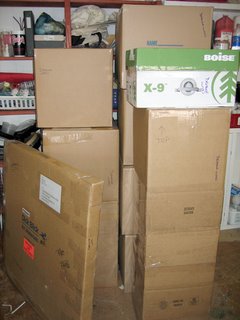 Packing artwork has been on my mind lately. I’ve spent the last couple of weekends packing up most of my work (10 boxes!) to ship off to a solo show at the Truckee Meadows Community College in Reno, Nevada. And I'm helping to make the boat payment for my local UPS Store owner...
I’m not an expert on packing and shipping artwork, but I have worked as a gallery assistant and I’ve unpacked artwork for a couple of national juried shows. So I do consider myself an expert on how NOT to pack and ship artwork. I have seen some amazingly stupidly packed boxes!
So I thought I would share some observations, tips, and techniques for packing and shipping that I’ve picked up over the years.
Reusable packing materials
First of all, if you’re shipping work that you know will be returned to you (a juried show, for example), then be sure to use easily reusable packing materials. Think about what it must be like at a juried show – there’s work coming in from all over the country, the people unpacking and repacking your work could be volunteers with little or no experience handling artwork – you want to make it as clear as possible for them to unpack your work and repack it after the show.
Avoid using packing peanuts. They’re not good protection because they can settle during shipping. They’re also a complete pain in the ass and gallery assistants hate them with a passion (at least my coworker and I did).
Clear instructions
It’s helpful to mark the spot on the box where you want it opened. As a gallery assistant, I LOVED the anal-retentive artists who sent unpacking and packing instructions (if you’re unpacking 50 boxes, you don’t want to have to think too hard about any of them). Just make it as easy as you possibly can. You don’t want the person who will be handling your artwork to be hating on you because you made her spend 20 minutes picking up peanuts or you wrapped something really tightly in so much bubble wrap that it won’t go back in the box later or realize that she opened the wrong end of the box and will have to spend extra time fixing it when she re-packs. Oh. Sorry. Flashbacks…
So when I pack something that is fairly complicated, I will include instructions. Pictures are also helpful, especially if the instructions are complicated.
Here’s an example of some instructions I wrote up for a fairly complicated package. I had 3 artist’s books in one box, and they had to be put back “just so” in order for them to fit. pdf file (120 KB)
Padding
Basically, you want to have as much protection between your artwork and the cold, cruel world as possible.
I pack my paintings in foam core boxes that I make myself. I then stack a few of those boxes inside a cardboard box. I line a larger box with foam and include the smaller box inside. So I basically have the paintings triple-boxed.
 a recent batch of foam core (and a few cardboard) inner boxes
Airfloat boxes
http://www.airfloatsys.com/
I’ve never used them myself, but I have unpacked quite a few. I think they’re fairly expensive, but they might be worth it for you.
The boxes are reinforced, easy to open, and re-usable. The boxes include 3 sheets of foam – one sheet protects your artwork on the bottom, one on the top, and you create a hole in the center piece of foam so that your piece fits snugly into it.
Crates
If you have tools and carpentry skills, you can make your own wooden crates. You can also have them made for you. Crates are expensive to ship because they’re usually heavy, but they can be good protection for your artwork, especially sculpture.
If you use a crate, be sure to mark very clearly which screws should be removed to open the crate.
To sum up, here is a basic list of packing tips that I created for local juried show participants:
Protect the artwork from dust and moisture:
- Wrap the artwork with protective, acid-free paper such as glassine or tissue paper
- Cover the artwork with white cotton fabric (recommended for textiles, ceramics, and wood)
- Wrap the artwork loosely in plastic
Protect the artwork from damage:
- If possible, use two containers; a smaller box cushioned on all sides inside a larger box can protect your artwork from bumps and sharp objects
- Insulate the artwork with padding such as bubble wrap, upholstery foam, or Styrofoam. NOT recommended: loose material such as any type of Styrofoam peanuts.
Identify your artwork:
To sum up, here is a basic list of packing tips that I created for local juried show participants:
Protect the artwork from dust and moisture:
- Wrap the artwork with protective, acid-free paper such as glassine or tissue paper
- Cover the artwork with white cotton fabric (recommended for textiles, ceramics, and wood)
- Wrap the artwork loosely in plastic
Protect the artwork from damage:
- If possible, use two containers; a smaller box cushioned on all sides inside a larger box can protect your artwork from bumps and sharp objects
- Insulate the artwork with padding such as bubble wrap, upholstery foam, or Styrofoam. NOT recommended: loose material such as any type of Styrofoam peanuts.
Identify your artwork:
- Include the artist’s name and the title on the back or bottom of the artwork
- Write your name on all exterior sides of all shipping containers using permanent marker
- Cover any paper labels with clear tape
- Identify your container as “FRAGILE” (ask your shipping company for labels)
- Identify where you would like the container to be opened by writing “OPEN THIS SIDE,” or “OPEN HERE”
- Include detailed unpacking and packing instructions
Resources:
http://www.airfloatsys.com/ - inexpensive, re-usable packaging solutions for shipping fine art
http://www.lightimpressionsdirect.com/ - archival materials
http://www.uline.com/ - boxes and plastic bags
- Write your name on all exterior sides of all shipping containers using permanent marker
- Cover any paper labels with clear tape
- Identify your container as “FRAGILE” (ask your shipping company for labels)
- Identify where you would like the container to be opened by writing “OPEN THIS SIDE,” or “OPEN HERE”
- Include detailed unpacking and packing instructions
Resources:
http://www.airfloatsys.com/ - inexpensive, re-usable packaging solutions for shipping fine art
http://www.lightimpressionsdirect.com/ - archival materials
http://www.uline.com/ - boxes and plastic bags
Update:
For textile artists, check out Lisa Call's post where she explains how she ships large quilts.
Thursday, November 23, 2006
Thankful.
I'm feeling reflective this Thanksgiving - I know I complain about a lot of things, but I know that I'm very lucky and I'm thankful for:
Sam - he makes me laugh every day and makes me realize what's important.
Family - I know they would do anything for me.
Friends - who have supported me and encouraged me and listened to me and laughed at my stupid jokes.
Health - something we all take for granted.
Art - it's allowed me to meet so many talented and creative and nice people.
I'm counting my blessings. I hope you have a wonderful and safe Thanksgiving!
Tuesday, October 31, 2006
Alternative exhibition spaces
Most artists strive for commercial acceptance and success. There are several paths to achieving those (often elusive) goals, commercial galleries being one of them. But if you’re having difficulty breaking into a commercial gallery or if you feel you might not be ready for one yet, there are many alternative spaces that you may want to consider.
I have to admit that I live in a town with two universities and a thriving art scene, so you can hardly go anywhere around here without seeing artwork from local artists and art students. But I’m sure you can find similar venues in your town.
I'm not going to cover rental galleries, vanity galleries, and community art centers. I'm going to focus on free spaces that might not currently exhibit art.
Some of these alternative spaces include:
Libraries
Cafes/restaurants
Coffee shops
Wine shops
Hair salons/spas
Fitness clubs/dojos
Dance studios
Record stores
Bank lobbies
Churches
Basically, any wall is a potential exhibition space.
Do some research. Visit different businesses in your town and notice if they have artwork hanging in their space. If they have changing exhibits, ask to speak to the person in charge of the artwork. Ask him or her about submission guidelines – would they like to see slides or a CD, view your website, or see actual work?
Carry a packet of information (or brochure or business card or CD) around with you to leave behind if the opportunity arises.
Approach businesses or spaces that relate to your work.
If you paint floral still lifes, you might approach a flower shop, garden shop, or a botanical garden. Figurative work might lend itself to a day spa. Landscapes from your trip to Italy would look great in that little Italian restaurant. Asian-inspired work might appeal to the owners of a dojo or karate school. Photographs of dancers in a dance studio. Watercolors of historic missions in your local Catholic church. You get the idea…
Some businesses that currently exhibit artwork from local artists might also already do receptions. If they don’t, you might brainstorm about how to do your own reception. They might be open to live music, jugglers, dancers, etc. Try to find something that would be mutually beneficial to both of you – getting your work seen and bringing in customers to the restaurant or shop.
Unused and empty retail spaces
Consider approaching the owner of a vacant space that would lend itself to your work. Maybe there’s an empty store on your town square that you could borrow or rent fairly cheaply for a couple of weeks. You would need to consider how to staff the space – posting specific gallery hours and having someone work as a gallery sitter.
Houses
A couple of years ago I went to a show at a gallery space that was actually a house. A couple of art students were renting a house and realized that they had a room that they weren’t using. They emptied out that room as well as their living room. Then they invited artists to have short (usually one or two-day) shows. They also knew music students and invited them to provide music for the reception/parties.
Things to consider
Trust your instincts.
If a restaurant owner seems shady or untrustworthy, tell them thanks anyway. Work out the details of sales – if they handle sales then usually they will take a commission. If they don’t want to deal with sales, they might have interested patrons contact you directly.
Find out what the venue will provide.
Some restaurants or shops might already have receptions and PR in place. You can just hang your show and show up for the reception. But others might leave that all up to you. If so, then you'll need to decide how you want to market the show. Consider writing a press release and sending out postcards to promote the show.
Be sure to have contact info available during your show.
Frame and hang an artist’s statement. Leave a stack of business cards or brochures.
It may be a great opportunity to show, but not sell.
If you look at it as a way to show your work to people who wouldn’t normally see it, then you’ll have a good experience. If you expect to sell every piece, then you might be disappointed.
Strength in numbers.
Enlist a group of artists to have a show with you. Find artists who do work in a similar theme, similar format, similar medium, etc. Having a group and assigning tasks helps to alleviate the work load associated with mounting a show.
What are some other alternative spaces that you’ve exhibited in? Were they successful? What did you do to make them successful?
I have to admit that I live in a town with two universities and a thriving art scene, so you can hardly go anywhere around here without seeing artwork from local artists and art students. But I’m sure you can find similar venues in your town.
I'm not going to cover rental galleries, vanity galleries, and community art centers. I'm going to focus on free spaces that might not currently exhibit art.
Some of these alternative spaces include:
Libraries
Cafes/restaurants
Coffee shops
Wine shops
Hair salons/spas
Fitness clubs/dojos
Dance studios
Record stores
Bank lobbies
Churches
Basically, any wall is a potential exhibition space.
Do some research. Visit different businesses in your town and notice if they have artwork hanging in their space. If they have changing exhibits, ask to speak to the person in charge of the artwork. Ask him or her about submission guidelines – would they like to see slides or a CD, view your website, or see actual work?
Carry a packet of information (or brochure or business card or CD) around with you to leave behind if the opportunity arises.
Approach businesses or spaces that relate to your work.
If you paint floral still lifes, you might approach a flower shop, garden shop, or a botanical garden. Figurative work might lend itself to a day spa. Landscapes from your trip to Italy would look great in that little Italian restaurant. Asian-inspired work might appeal to the owners of a dojo or karate school. Photographs of dancers in a dance studio. Watercolors of historic missions in your local Catholic church. You get the idea…
Some businesses that currently exhibit artwork from local artists might also already do receptions. If they don’t, you might brainstorm about how to do your own reception. They might be open to live music, jugglers, dancers, etc. Try to find something that would be mutually beneficial to both of you – getting your work seen and bringing in customers to the restaurant or shop.
Unused and empty retail spaces
Consider approaching the owner of a vacant space that would lend itself to your work. Maybe there’s an empty store on your town square that you could borrow or rent fairly cheaply for a couple of weeks. You would need to consider how to staff the space – posting specific gallery hours and having someone work as a gallery sitter.
Houses
A couple of years ago I went to a show at a gallery space that was actually a house. A couple of art students were renting a house and realized that they had a room that they weren’t using. They emptied out that room as well as their living room. Then they invited artists to have short (usually one or two-day) shows. They also knew music students and invited them to provide music for the reception/parties.
Things to consider
Trust your instincts.
If a restaurant owner seems shady or untrustworthy, tell them thanks anyway. Work out the details of sales – if they handle sales then usually they will take a commission. If they don’t want to deal with sales, they might have interested patrons contact you directly.
Find out what the venue will provide.
Some restaurants or shops might already have receptions and PR in place. You can just hang your show and show up for the reception. But others might leave that all up to you. If so, then you'll need to decide how you want to market the show. Consider writing a press release and sending out postcards to promote the show.
Be sure to have contact info available during your show.
Frame and hang an artist’s statement. Leave a stack of business cards or brochures.
It may be a great opportunity to show, but not sell.
If you look at it as a way to show your work to people who wouldn’t normally see it, then you’ll have a good experience. If you expect to sell every piece, then you might be disappointed.
Strength in numbers.
Enlist a group of artists to have a show with you. Find artists who do work in a similar theme, similar format, similar medium, etc. Having a group and assigning tasks helps to alleviate the work load associated with mounting a show.
What are some other alternative spaces that you’ve exhibited in? Were they successful? What did you do to make them successful?
Wednesday, October 18, 2006
MOO cards
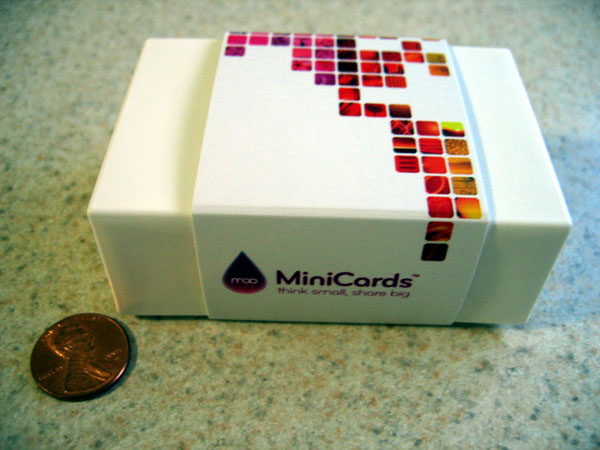 My little box of MOO MiniCards was waiting for me in the mailbox today! I'm very excited. They're so cute!
They're packaged in a cute little box with a sleeve. Inside are 100, 2 3/4" x 1 1/8" cards - less than half the size of a standard business card.
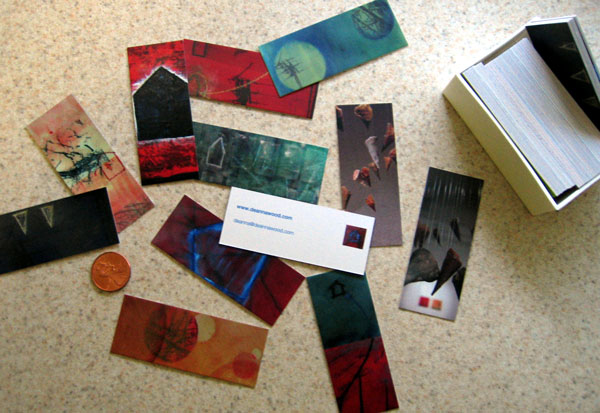 The images on the backs can be all different (I think I got 3 of each of mine) - you can get 100 different images. This is what's so exciting to me. Maybe I'm easily amused?
 You can put up to 4 lines of information on the front and you have a limited choice of fonts and colors.
They take your images from your flickr page, so you have to have a flickr account (they're free). You can select the images you want to use and select the areas that you want to print. Most of my paintings are square, so the format was a little odd - most of my cards ended up being essentially details of paintings.
You also need to make sure that you upload higher-res images than you normally would. They recommend 640 x 480. A couple of mine were only 300 x 300 and they turned out fine, though.
Oh, and I guess they were fairly pricey for only 100 cards ($19.99), but you can get 100 different images, for cryin' out loud! How cool is that? And did I mention that they're super cute?
Check 'em out!
www.moo.com
www.flickr.com
Friday, October 13, 2006
Submission Guidelines
A bit of a diversion...
Everything about McSweeney's is great. Especially today's Submission Guidelines for Our Refrigerator Door.
An excerpt:
We are no longer accepting robot-monkey-themed work, be they drawings, stories, or whatever. We've had it up to here with robot monkeys. Yes, robot monkeys are "funny" and "cool" and they make "amazing" beeping sounds, but enough is enough with the robot monkeys. Robot monkeys are so last July. And no saying that something is a tree and then later telling us it's a robot monkey. That will lead to immediate removal from our refrigerator door, and no amount of crying and spinning wildly on the floor will make us put it back up.
Check it out!
Everything about McSweeney's is great. Especially today's Submission Guidelines for Our Refrigerator Door.
An excerpt:
We are no longer accepting robot-monkey-themed work, be they drawings, stories, or whatever. We've had it up to here with robot monkeys. Yes, robot monkeys are "funny" and "cool" and they make "amazing" beeping sounds, but enough is enough with the robot monkeys. Robot monkeys are so last July. And no saying that something is a tree and then later telling us it's a robot monkey. That will lead to immediate removal from our refrigerator door, and no amount of crying and spinning wildly on the floor will make us put it back up.
Check it out!
Wednesday, October 11, 2006
Taxes
Math, accounting, record keeping, and taxes. I know. Yuck. Most artists hate all of this, but it’s important that you understand at least some of the issues so that you’re not paying too much - or (maybe) worse, not paying enough - which could result in an audit, fines, and penalties.
A few years ago, when I set a goal to make a living as an artist, I decided that I would keep track of my expenses and income. Partly as a psychological boost – to show that I was serious about being an artist.
Recently my local art group, VAST invited an accountant to talk to the group about tax issues for artists. I wanted to let you know what he said and give you some basic ideas to get started on your record keeping. I want to stress that he was talking specifically about issues related to artists in Texas, and he was just answering general questions. So if you need to know something specific to your situation, please contact an accountant in your area.
So here are some of the things he suggested:
Get a separate bank account for your art business
This helps simplify record keeping. Pay for your supplies out of this account and deposit your income from art sales, teaching, commissions, etc. into this account.
Avoid using a debit or credit card
People tend to spend more when using plastic as opposed to cash or checks.
Keep good records with financial software (like Quicken)
It’s easy to use and you can set up categories like art supplies, meals and entertainment, travel, education, etc.
Tax exempt status
Use tax exempt status to buy consumable items such as paint, paper, canvas, wood (anything that becomes part of your artwork). You have to pay tax on things you use but keep, such as brushes, tools, easels, tables, etc.
Forming a corporation doesn’t usually benefit you
Until you’re making $30K or $40K per year.
Mileage
You can claim mileage but you must keep accurate records. The going rate right now is 44.5 cents/mile. You can keep a notebook in your car and jot down your odometer readings every time you drive to your studio, to meet a client, visit a gallery, etc. It has to be business-related.
You’re responsible for sales tax on your artwork
If you’re not charging your customers sales tax, then you have to pay it. Most gallery owners will take care of the sales tax, so sales through a gallery usually aren’t a problem. But when you’re selling at an art fair or out of your studio, you need to be charging tax. This is a subject that I’m not really clear on, so definitely consult a professional.
Studio space
It’s best if your studio is a separate structure that is solely dedicated to your business, but you can also get a deduction for studio space within your home. The benefit to claiming an in-home studio is that you can claim mileage on any trips you take away from your studio on business. The example he gave was a musician – if the musician travels to different locations to perform or give lessons, he/she can’t deduct the mileage. But if he/she has a separate studio (even just a section of a bedroom), then any trips away from the studio are deductible. Presumably you can deduct rent, utilities, etc. You definitely want to consult a professional on this question…
Hopefully some of these tips will help you – or at least alert you to things you may need to look into.
Here are some resources with more information:
NYFA article on taxes
Lots of articles from All Creative Portfolios
The Artist Help Network has a listing of helpful books
Volunteer Lawyers for the Arts has lots of info
A few years ago, when I set a goal to make a living as an artist, I decided that I would keep track of my expenses and income. Partly as a psychological boost – to show that I was serious about being an artist.
Recently my local art group, VAST invited an accountant to talk to the group about tax issues for artists. I wanted to let you know what he said and give you some basic ideas to get started on your record keeping. I want to stress that he was talking specifically about issues related to artists in Texas, and he was just answering general questions. So if you need to know something specific to your situation, please contact an accountant in your area.
So here are some of the things he suggested:
Get a separate bank account for your art business
This helps simplify record keeping. Pay for your supplies out of this account and deposit your income from art sales, teaching, commissions, etc. into this account.
Avoid using a debit or credit card
People tend to spend more when using plastic as opposed to cash or checks.
Keep good records with financial software (like Quicken)
It’s easy to use and you can set up categories like art supplies, meals and entertainment, travel, education, etc.
Tax exempt status
Use tax exempt status to buy consumable items such as paint, paper, canvas, wood (anything that becomes part of your artwork). You have to pay tax on things you use but keep, such as brushes, tools, easels, tables, etc.
Forming a corporation doesn’t usually benefit you
Until you’re making $30K or $40K per year.
Mileage
You can claim mileage but you must keep accurate records. The going rate right now is 44.5 cents/mile. You can keep a notebook in your car and jot down your odometer readings every time you drive to your studio, to meet a client, visit a gallery, etc. It has to be business-related.
You’re responsible for sales tax on your artwork
If you’re not charging your customers sales tax, then you have to pay it. Most gallery owners will take care of the sales tax, so sales through a gallery usually aren’t a problem. But when you’re selling at an art fair or out of your studio, you need to be charging tax. This is a subject that I’m not really clear on, so definitely consult a professional.
Studio space
It’s best if your studio is a separate structure that is solely dedicated to your business, but you can also get a deduction for studio space within your home. The benefit to claiming an in-home studio is that you can claim mileage on any trips you take away from your studio on business. The example he gave was a musician – if the musician travels to different locations to perform or give lessons, he/she can’t deduct the mileage. But if he/she has a separate studio (even just a section of a bedroom), then any trips away from the studio are deductible. Presumably you can deduct rent, utilities, etc. You definitely want to consult a professional on this question…
Hopefully some of these tips will help you – or at least alert you to things you may need to look into.
Here are some resources with more information:
NYFA article on taxes
Lots of articles from All Creative Portfolios
The Artist Help Network has a listing of helpful books
Volunteer Lawyers for the Arts has lots of info
Friday, October 06, 2006
Group Show at exploding head gallery

My work is part of a group show called Architectural Forms at exploding head gallery in Sacramento, California.
The show runs until October 28th. The reception is October 14th from 6-9 pm.
If you're in the area, check it out!
Wednesday, October 04, 2006
Postcards
Postcards are a great way to advertise an upcoming show. They’re also great to have later, to tuck into your packets that you send to galleries. If you’re having a show in a commercial gallery, art center or university gallery, most likely they will design the postcards and have them printed. They will probably give you a small number that you can mail to select people on your mailing list.
But if you’re organizing your own show (in an alternative space, rental gallery, student gallery, etc.), then you’ll probably be on your own to design and print your postcards.
Steps to creating an effective postcard
1. Put a striking image on the front
Start with a great photograph or slide of your work. Pick the best piece from your show and get a great shot of it. An intriguing detail shot can be interesting and mysterious. If you don’t have a good camera or you lack photography skills, hire a professional photographer to shoot it for you.
It’s important to start with a good quality, high-resolution photograph (slide or digital). If you attempt to print from a 72 dpi jpg, you’ll get jagged, fuzzy, ugly results.
It's also a good idea to put your name on the front.
2. Include all important information on the back
I can’t count the occasions where I’ve gotten postcards for art shows that left out something crucial – like the artist’s name, the dates of the show, location, etc.
What you should include:
Your name (preferably on both sides)
Title of the show
Location
Date (including the year)
Gallery hours
Reception date, if there is one
Information about the work you featured on the front of the card (title, medium, size)
Return address (the post office will return any with bad addresses – important to be able to keep your mailing list current)
Your website url
All of this information should be clean and easy to read. Don’t use funky fonts here. The title and your name can be in a larger size and bold, and possibly in a different (but not too different) font. Try to limit yourself to 2 or 3 sizes and no more than 2 different fonts. Don’t use any sizes below 8 point.
I don’t think there’s any reason to use color on the back of a postcard. Seems like a waste of money to me. Black ink is effective and readable.
Here’s an example:
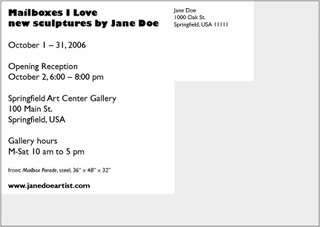
3. Follow postal guidelines
The post office won’t mail anything below a certain size (3.5” x 5”) and there’s a maximum size for mailing at the postcard rate (4.25” x 6”).
Size guidelines: http://pe.usps.gov/text/qsg300/Q201.htm
There are also certain areas that the post office designates for printing their own barcodes, etc. In the example above, the grey areas are off-limits for text or graphics. The white area is free.
Printing your own
If you’re having a smaller show, or just want to limit your mailing, it’s possible to create your own postcards on your computer and print them yourself at your local copy shop.
The easiest way to do this is to lay out your postcards 4-up on a page, copy them, and have the copy shop cut them for you.
The resulting postcards will be 4.25” x 5.5” – a little under the standard postcard size (4.25” x 6”), but still within the accepted size for the post office.
You’ll need a decent illustration or page layout program such as Illustrator, FreeHand, InDesign, or Quark – even Photoshop, in a pinch. I wouldn’t recommend designing them in Microsoft Word (shudder) or PowerPoint (cringe) unless that was your absolute only choice.
Enlist the help of a graphic designer if you don’t feel that you can do it yourself. Your local copy shop probably offers this service.
Professional printing
For slick, colorful, glossy, professional results, get your cards printed by a commercial printer. If you know and trust a local print shop, then use them.
Most artists use a company called Modern Postcard. They’re great quality and pretty quick. You can get 500 4.25” x 6” postcards for $129 plus shipping.
You can design your own and send it to them or send them all your info and they’ll do it for you (but I think it costs a little bit more).
If you don’t need 500 postcards, check out Overnight Prints. I recently discovered them and they’re my new favorite. Their shortest run is 250 (a much more manageable quantity - for me, at least). I recently got 250 postcards for around $50 (including shipping).
They work the same as Modern Postcard – send them a file or have them create the postcard for you.
Both companies have templates in different programs that you can download. They also offer design advice and will show you examples of good and bad postcards. If you intend to design your postcards yourself, be sure to follow their guidelines (file formats, software programs, dpi, cmyk, bleeds, etc).
The postcards are printed in big batches (they’ll gang 20 or so different postcards onto one sheet), so it’s possible that the quality (especially color) can suffer. I’ve always gotten good results, though.
I would recommend getting your postcards professionally printed as opposed to running copies. The main advantage is that they look much more professional. A disadvantage is that you will be stuck with a bunch of leftover cards.
You can extend the life of a card by leaving the back blank. You can print your specific show information on a sticker and adhere it to the back before you send it. As long as the image on the front is not too specific and will represent your work for a couple of years, this is a good strategy. You can even use them as regular postcards, thank you notes, etc.
Useful beyond the show
I have quite a few postcards left over from past shows. I send them out with my marketing packets, leave them out for people to pick up at shows and at my studio, and hand them out to people every now and then. They’re a great marketing tool.
But if you’re organizing your own show (in an alternative space, rental gallery, student gallery, etc.), then you’ll probably be on your own to design and print your postcards.
Steps to creating an effective postcard
1. Put a striking image on the front
Start with a great photograph or slide of your work. Pick the best piece from your show and get a great shot of it. An intriguing detail shot can be interesting and mysterious. If you don’t have a good camera or you lack photography skills, hire a professional photographer to shoot it for you.
It’s important to start with a good quality, high-resolution photograph (slide or digital). If you attempt to print from a 72 dpi jpg, you’ll get jagged, fuzzy, ugly results.
It's also a good idea to put your name on the front.
2. Include all important information on the back
I can’t count the occasions where I’ve gotten postcards for art shows that left out something crucial – like the artist’s name, the dates of the show, location, etc.
What you should include:
Your name (preferably on both sides)
Title of the show
Location
Date (including the year)
Gallery hours
Reception date, if there is one
Information about the work you featured on the front of the card (title, medium, size)
Return address (the post office will return any with bad addresses – important to be able to keep your mailing list current)
Your website url
All of this information should be clean and easy to read. Don’t use funky fonts here. The title and your name can be in a larger size and bold, and possibly in a different (but not too different) font. Try to limit yourself to 2 or 3 sizes and no more than 2 different fonts. Don’t use any sizes below 8 point.
I don’t think there’s any reason to use color on the back of a postcard. Seems like a waste of money to me. Black ink is effective and readable.
Here’s an example:

3. Follow postal guidelines
The post office won’t mail anything below a certain size (3.5” x 5”) and there’s a maximum size for mailing at the postcard rate (4.25” x 6”).
Size guidelines: http://pe.usps.gov/text/qsg300/Q201.htm
There are also certain areas that the post office designates for printing their own barcodes, etc. In the example above, the grey areas are off-limits for text or graphics. The white area is free.
Printing your own
If you’re having a smaller show, or just want to limit your mailing, it’s possible to create your own postcards on your computer and print them yourself at your local copy shop.
The easiest way to do this is to lay out your postcards 4-up on a page, copy them, and have the copy shop cut them for you.
The resulting postcards will be 4.25” x 5.5” – a little under the standard postcard size (4.25” x 6”), but still within the accepted size for the post office.
You’ll need a decent illustration or page layout program such as Illustrator, FreeHand, InDesign, or Quark – even Photoshop, in a pinch. I wouldn’t recommend designing them in Microsoft Word (shudder) or PowerPoint (cringe) unless that was your absolute only choice.
Enlist the help of a graphic designer if you don’t feel that you can do it yourself. Your local copy shop probably offers this service.
Professional printing
For slick, colorful, glossy, professional results, get your cards printed by a commercial printer. If you know and trust a local print shop, then use them.
Most artists use a company called Modern Postcard. They’re great quality and pretty quick. You can get 500 4.25” x 6” postcards for $129 plus shipping.
You can design your own and send it to them or send them all your info and they’ll do it for you (but I think it costs a little bit more).
If you don’t need 500 postcards, check out Overnight Prints. I recently discovered them and they’re my new favorite. Their shortest run is 250 (a much more manageable quantity - for me, at least). I recently got 250 postcards for around $50 (including shipping).
They work the same as Modern Postcard – send them a file or have them create the postcard for you.
Both companies have templates in different programs that you can download. They also offer design advice and will show you examples of good and bad postcards. If you intend to design your postcards yourself, be sure to follow their guidelines (file formats, software programs, dpi, cmyk, bleeds, etc).
The postcards are printed in big batches (they’ll gang 20 or so different postcards onto one sheet), so it’s possible that the quality (especially color) can suffer. I’ve always gotten good results, though.
I would recommend getting your postcards professionally printed as opposed to running copies. The main advantage is that they look much more professional. A disadvantage is that you will be stuck with a bunch of leftover cards.
You can extend the life of a card by leaving the back blank. You can print your specific show information on a sticker and adhere it to the back before you send it. As long as the image on the front is not too specific and will represent your work for a couple of years, this is a good strategy. You can even use them as regular postcards, thank you notes, etc.
Useful beyond the show
I have quite a few postcards left over from past shows. I send them out with my marketing packets, leave them out for people to pick up at shows and at my studio, and hand them out to people every now and then. They’re a great marketing tool.
Sunday, October 01, 2006
My process
Tracy Helgeson, one of the wonderful new bloggers that I've discovered lately has been using her blog to document her painting process. I find it intriguing to see the different stages that a work of art goes through.
With that in mind, I'd like to share a bit of my process.
For the last 2 years, I've been working exclusively with the encaustic process. I create what is called wax medium by melting beeswax and adding damar crystals - a natrual resin that damar varnish is made from. The resin raises the melting temperature of the wax and makes it a little more durable.
I will often use the medium without adding any pigment, brushing it over collage elements and then working back into the wax - scraping, scratching, adding oil paint, oil pastel, more collage with tissue paper, objects, etc.
But sometimes I will create what is called encaustic paint. You can buy encaustic paint in hundreds of colors, but I like to create my own by adding oil paint. This method is usually not as opaque and bright as the prepared paints, but I prefer more transparency, so it works for me. Oh, and I'm also really cheap - the encaustic paints are a little pricey. :-)
 Here's a photo of my studio. Note the fan in the window - this helps to draw out harmful fumes from the wax. It's a bit ghetto - just a bathroom exhaust fan in a piece of scrap wood - but it works.
I melt my wax in electric skillets and mix paint into small tins that I keep hot on a pancake griddle.
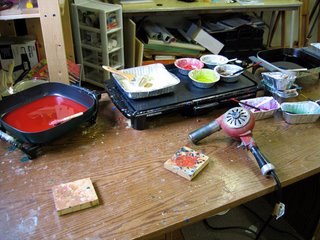 I use a heat gun (that scary hair-dryer-looking thing) to fuse the wax to the surface and to each layer of wax that I add.
I normally start with a prepared board - I love the Ampersand "Cradled Hardbord" boards, but sometimes I can't find a good price. I will often buy the "Gessobord" boards and cover them with paper in order to make them compatible with encaustic (wax has to have something absorbent to adhere to, so it's not recommended that you apply encaustic over acrylic, glass, plastic, metal, etc. - although you see people doing it all the time).
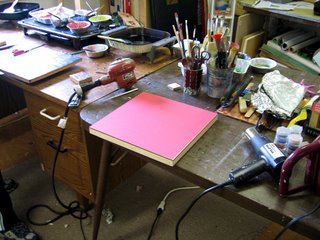 So this is a Gessobord with paper glued onto the gessoed surface. I use Yes glue, which is a great glue for collage. I put something heavy on it and let it sit over night. I drew some state border lines with oil pastel - you can't really see it in this photo...
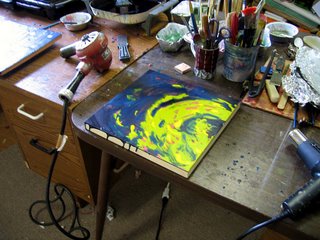 I then painted on some tinted encaustic paint and then fused it with the heat gun. I was going for a bit of a blended look, much like the colors on the weather radar.
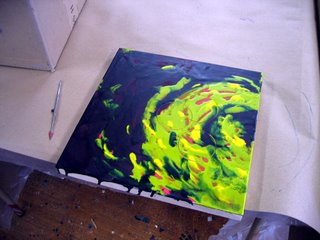 I then scribed some circular shapes into the wax surface.
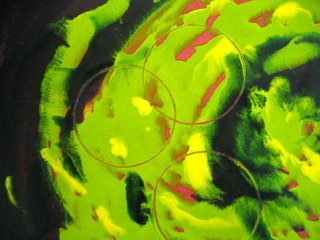 The detail shows the circles...
 Rotation 1 - 12" x 12" - collage, oil pastel, and encaustic on panel
The finished piece - I rubbed oil pastel into the lines of the circles.
I was influenced by the weather radar when a big storm was blowing through the Dallas area. I was intrigued by the circles that kind of pulsated, indicating rotation in the storm (and a possible tornado). I don't know if that's a new development in radar technology, but I had never noticed it before.
 So while my son and I were cowering in the hallway, listening to KNTU, I was thinking about this painting. Well, mostly I was saying, "No, there's probably not a tornado. They're just being safe..." But in the back of my mind...
With that in mind, I'd like to share a bit of my process.
For the last 2 years, I've been working exclusively with the encaustic process. I create what is called wax medium by melting beeswax and adding damar crystals - a natrual resin that damar varnish is made from. The resin raises the melting temperature of the wax and makes it a little more durable.
I will often use the medium without adding any pigment, brushing it over collage elements and then working back into the wax - scraping, scratching, adding oil paint, oil pastel, more collage with tissue paper, objects, etc.
But sometimes I will create what is called encaustic paint. You can buy encaustic paint in hundreds of colors, but I like to create my own by adding oil paint. This method is usually not as opaque and bright as the prepared paints, but I prefer more transparency, so it works for me. Oh, and I'm also really cheap - the encaustic paints are a little pricey. :-)
 Here's a photo of my studio. Note the fan in the window - this helps to draw out harmful fumes from the wax. It's a bit ghetto - just a bathroom exhaust fan in a piece of scrap wood - but it works.
I melt my wax in electric skillets and mix paint into small tins that I keep hot on a pancake griddle.
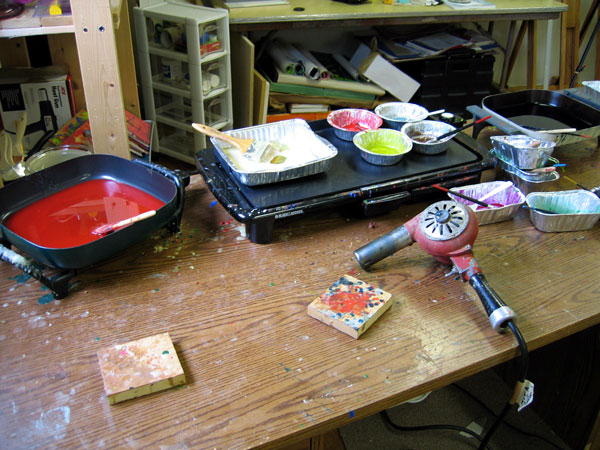 I use a heat gun (that scary hair-dryer-looking thing) to fuse the wax to the surface and to each layer of wax that I add.
I normally start with a prepared board - I love the Ampersand "Cradled Hardbord" boards, but sometimes I can't find a good price. I will often buy the "Gessobord" boards and cover them with paper in order to make them compatible with encaustic (wax has to have something absorbent to adhere to, so it's not recommended that you apply encaustic over acrylic, glass, plastic, metal, etc. - although you see people doing it all the time).
 So this is a Gessobord with paper glued onto the gessoed surface. I use Yes glue, which is a great glue for collage. I put something heavy on it and let it sit over night. I drew some state border lines with oil pastel - you can't really see it in this photo...
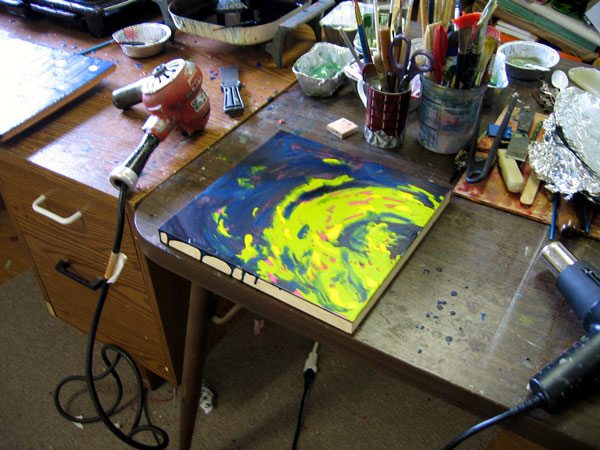 I then painted on some tinted encaustic paint and then fused it with the heat gun. I was going for a bit of a blended look, much like the colors on the weather radar.
 I then scribed some circular shapes into the wax surface.
 The detail shows the circles...
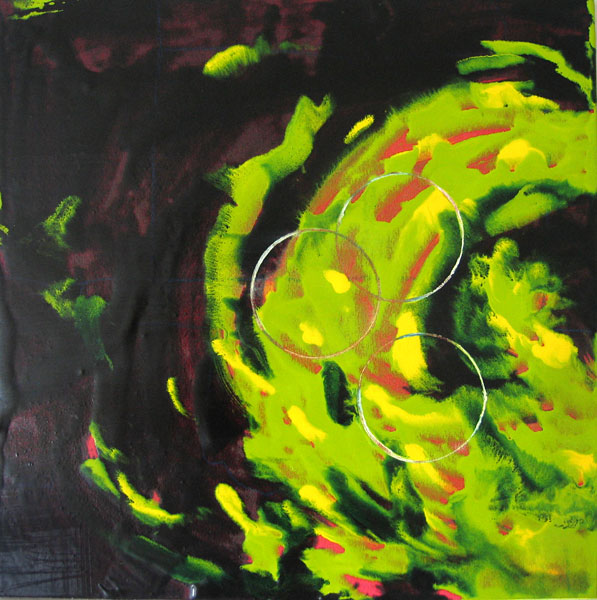 Rotation 1 - 12" x 12" - collage, oil pastel, and encaustic on panel
The finished piece - I rubbed oil pastel into the lines of the circles.
I was influenced by the weather radar when a big storm was blowing through the Dallas area. I was intrigued by the circles that kind of pulsated, indicating rotation in the storm (and a possible tornado). I don't know if that's a new development in radar technology, but I had never noticed it before.
 So while my son and I were cowering in the hallway, listening to KNTU, I was thinking about this painting. Well, mostly I was saying, "No, there's probably not a tornado. They're just being safe..." But in the back of my mind...
Friday, September 29, 2006
What is an emerging artist?
In response to my comment on Tracy’s blog, Karen wondered about the term "emerging artist."
It’s an ambiguous term that generally means an artist who’s just beginning his or her career.
When I see descriptions of galleries, they usually indicate the types of artists they represent (landscape, abstract, Russian, African-American, etc.) and also what career stage (emerging, mid-career, or established). At this point, I would never submit my work to a gallery that only represented mid-career and/or established artists.
So here’s what “emerging artist” means to me:
No longer a student.
Had a few solo shows and/or asked to be in some invitational shows.
Serious about his or her art - may not be a full-time artist but considers him or herself an artist and actively creates and markets the work.
Hasn’t had a museum show.
Isn’t necessarily in a lot of public or private collections.
But I have no idea how long you have to work as an “emerging artist” in order to go on to the next stage. Maybe after you’ve been working for 20 years you can consider yourself mid-career? Or after you have your first museum show? Or when Art Forum writes an article about you?
Do you consider yourself “emerging?” Why? If not, why not?
Wednesday, September 27, 2006
Self Doubt
I'm always worried when I send my paintings out into the world. I'm afraid that when someone sees them in person, they'll be disappointed. Perhaps a gallery owner will like the images on my website but when they see the actual paintings, they'll say, "Ick. What was I thinking?"
But that's what it's all about, really. You do your best to create your work and then when it's out of your hands it has a life of its own. There's always that risk that you'll get negative feedback or criticism. I suppose if you weren't willing to risk it, you'd just hide your paintings in a closet.
I sent some paintings off to a gallery earlier this week and have been having those secret worries and fears. The gallery owner sent me an email that said, "I received your paintings this morning and I'm thrilled. They are everything I hoped they would be."
How cool is that?
But that's what it's all about, really. You do your best to create your work and then when it's out of your hands it has a life of its own. There's always that risk that you'll get negative feedback or criticism. I suppose if you weren't willing to risk it, you'd just hide your paintings in a closet.
I sent some paintings off to a gallery earlier this week and have been having those secret worries and fears. The gallery owner sent me an email that said, "I received your paintings this morning and I'm thrilled. They are everything I hoped they would be."
How cool is that?
Tuesday, September 26, 2006
Art Biz Blog
Thanks to Alyson Stanfield at the Art Biz Blog for mentioning this blog!
I just recently discovered her blog - tons of great information there. For some reason I've been on an "inspiration" kick lately - looking for information on how to stay inspired. Alyson has a bunch of great posts on inspiration. Be sure to check it out!
I just recently discovered her blog - tons of great information there. For some reason I've been on an "inspiration" kick lately - looking for information on how to stay inspired. Alyson has a bunch of great posts on inspiration. Be sure to check it out!
Friday, September 22, 2006
More Resources
I think I forgot to mention a really useful book - The Practical Handbook for the Emerging Artist by Margaret R. Lazzari. It was a required book for the professional practices class that I took in grad school.
You'll find lots of information on getting your work out, making contacts, finding alternative exhibition spaces, documenting your work, researching galleries, and curating shows. There are even several interviews with artists. A great resource.
Alyson B. Stanfield at the Art Biz Blog posts lots of great information for emerging artists. Great stuff about pricing, getting into galleries, marketing, etc.
I just happened upon this website for the University of Texas at Austin's Fine Art Career Services. It's primarily for students and recent graduates of UT, but anyone can access the information. There's information on finding a job or internship, writing a CV, and there's even a Career Guide for Studio Art Majors (pdf file).
If you're a crafter or are thinking about starting a craft business, Make It is a great blog. Find information on where to sell your craft items, get organized, find inspiration, etc.
Please post any other resources that I might not have mentioned!
You'll find lots of information on getting your work out, making contacts, finding alternative exhibition spaces, documenting your work, researching galleries, and curating shows. There are even several interviews with artists. A great resource.
Alyson B. Stanfield at the Art Biz Blog posts lots of great information for emerging artists. Great stuff about pricing, getting into galleries, marketing, etc.
I just happened upon this website for the University of Texas at Austin's Fine Art Career Services. It's primarily for students and recent graduates of UT, but anyone can access the information. There's information on finding a job or internship, writing a CV, and there's even a Career Guide for Studio Art Majors (pdf file).
If you're a crafter or are thinking about starting a craft business, Make It is a great blog. Find information on where to sell your craft items, get organized, find inspiration, etc.
Please post any other resources that I might not have mentioned!
Tuesday, September 19, 2006
Progress Report
I've been OCD lately and I've compiled a list of the galleries that I've sent my brochure to. These were mostly galleries that I researched from the Art in America Gallery Guide. I've been wondering how many I mailed out and how many responded...
Starting in April of 2005, I sent my brochure and cover letter to 168 galleries from Arizona to Wisconsin.
Rejection
As of September, 2006, I've received 39 rejection letters (some form letters, some hand-written notes, and a few with valuable feedback).
Acceptance
I've received interest from 5 galleries for possible group shows in the future.
A gallery invited me to participate in a group show.
I received gallery representation and that gallery recently sold two of my paintings. That paid for my brochure printing and postage right there...
Consultants
Three months ago, I sent my brochure, cover letter, and CD to 15 consultants (also from the Art in America Gallery Guide). I've only received one letter - a rejection... It's still fairly soon, though.
Thoughts
It was interesting to look back through the rejection letters. I so appreciate the people who took the time to write a note or give specific feedback, although after a while, I was happy to even get a form rejection letter. Well, not happy, but you know what I mean...
Next steps
I still have a list of galleries that had specific submission guidelines. I'm going to double check their websites one more time (to make sure they're still accepting submissions) and send them packets. I was specifically looking for galleries that would accept CDs. I haven't taken slides in a while - I document my work digitally now. Anyway, slides are just too dang expensive to send out to just sit on somebody's desk for six months.
I'm going to add all of the galleries that sent me rejection letters to my mailing list. Many of them specifically said, "Keep us on your mailing list," or "We'd like to see your work in the future." So who knows? Maybe someone who rejected me last year will like my work next year...
Starting in April of 2005, I sent my brochure and cover letter to 168 galleries from Arizona to Wisconsin.
Rejection
As of September, 2006, I've received 39 rejection letters (some form letters, some hand-written notes, and a few with valuable feedback).
Acceptance
I've received interest from 5 galleries for possible group shows in the future.
A gallery invited me to participate in a group show.
I received gallery representation and that gallery recently sold two of my paintings. That paid for my brochure printing and postage right there...
Consultants
Three months ago, I sent my brochure, cover letter, and CD to 15 consultants (also from the Art in America Gallery Guide). I've only received one letter - a rejection... It's still fairly soon, though.
Thoughts
It was interesting to look back through the rejection letters. I so appreciate the people who took the time to write a note or give specific feedback, although after a while, I was happy to even get a form rejection letter. Well, not happy, but you know what I mean...
Next steps
I still have a list of galleries that had specific submission guidelines. I'm going to double check their websites one more time (to make sure they're still accepting submissions) and send them packets. I was specifically looking for galleries that would accept CDs. I haven't taken slides in a while - I document my work digitally now. Anyway, slides are just too dang expensive to send out to just sit on somebody's desk for six months.
I'm going to add all of the galleries that sent me rejection letters to my mailing list. Many of them specifically said, "Keep us on your mailing list," or "We'd like to see your work in the future." So who knows? Maybe someone who rejected me last year will like my work next year...
Tuesday, September 12, 2006
Types of Galleries
When I decided that I was ready to let my work loose on the world, I looked around for advice in books, from teachers, and from other artists. I heard:
“Get your work out there.”
“Show wherever you can.”
“Get shows on your resume.”
“New York! It’s so important to get a show in New York!”
So I read Art Deadlines List, Art Calendar, and surfed all the art opps boards I could find. I entered a ton of juried shows, especially the ones in New York and the ones with big-time New York critics and curators as jurors.
That particular year, I think I got into a couple of shows - none of the New York ones, though. But I did receive an interesting letter from one of the galleries there that had sponsored one of the shows I entered. It said something like, “The juror rejected your work, but we really like it. We would like to invite you to join our gallery.” It proceeded to recommend the gallery and the advantages of being able to show in New York, etc. There were different levels at which I could “join,” and which would allow me different amounts of wall space in upcoming group shows. They said that they advertised in prominent art publications, promote their artists, yadda yadda yadda. It all sounded really nice until I saw the price list of the membership levels. I think the cheapest one was still over $2000. That’s a lot to pay for a line on your resume.
Vanity Galleries
One of my professors looked over the letter and told me that the gallery was what is known as a “vanity gallery.” She explained to me that the problem with vanity galleries is that most of them have a reputation as just that - a gallery in which someone has paid to show their work just to get New York on his or her resume. For the most part, vanity galleries don’t promote and develop relationships with artists like reputable commercial galleries do. And it won’t necessarily impress a gallery director if he or she sees it on your resume.
Rental Galleries
Rental galleries are a little different. Although they might not have the same prestige that a commercial gallery or an alternative space might have, they are definitely a viable place to show your work, especially if you’re just starting out and need experience showing.
Most rental galleries charge a flat rate for a specific period of time, say $200 for 3 weeks. It will most likely be a “do it yourself” type of operation. You hang the artwork, design the invitations, do the PR, schedule and host the reception, and sometimes you might even have to staff the gallery.
This is great experience for someone starting out or for a group of artists who want to show together but might not have another venue available.
Obviously you’ll want to find a gallery near your home, especially if gallery-sitting is involved.
Co-op Galleries
Co-op galleries are different still. A co-op gallery usually involves a group of artists who work together to show their work, promote the gallery, and sometimes offer community art classes or workshops. Some co-op galleries will even have studio space available for their members to create artwork on site.
The co-op gallery will require a membership fee, which will go towards gallery maintenance, rent, promotion, etc. You may have to pay a commission to the gallery as well, upon the sale of your artwork.
The main difference between a vanity gallery and a co-op gallery is that the artists in the co-op are invested in the running of the gallery. This can also be a great way to get experience with shows, to meet other artists, critics, curators, etc.
You’ll most likely want to be as involved as you can, so being physically close to the gallery will be important.
I have had good experiences with rental and co-op galleries, but I’m trying to stay away from the vanity galleries...
“Get your work out there.”
“Show wherever you can.”
“Get shows on your resume.”
“New York! It’s so important to get a show in New York!”
So I read Art Deadlines List, Art Calendar, and surfed all the art opps boards I could find. I entered a ton of juried shows, especially the ones in New York and the ones with big-time New York critics and curators as jurors.
That particular year, I think I got into a couple of shows - none of the New York ones, though. But I did receive an interesting letter from one of the galleries there that had sponsored one of the shows I entered. It said something like, “The juror rejected your work, but we really like it. We would like to invite you to join our gallery.” It proceeded to recommend the gallery and the advantages of being able to show in New York, etc. There were different levels at which I could “join,” and which would allow me different amounts of wall space in upcoming group shows. They said that they advertised in prominent art publications, promote their artists, yadda yadda yadda. It all sounded really nice until I saw the price list of the membership levels. I think the cheapest one was still over $2000. That’s a lot to pay for a line on your resume.
Vanity Galleries
One of my professors looked over the letter and told me that the gallery was what is known as a “vanity gallery.” She explained to me that the problem with vanity galleries is that most of them have a reputation as just that - a gallery in which someone has paid to show their work just to get New York on his or her resume. For the most part, vanity galleries don’t promote and develop relationships with artists like reputable commercial galleries do. And it won’t necessarily impress a gallery director if he or she sees it on your resume.
Rental Galleries
Rental galleries are a little different. Although they might not have the same prestige that a commercial gallery or an alternative space might have, they are definitely a viable place to show your work, especially if you’re just starting out and need experience showing.
Most rental galleries charge a flat rate for a specific period of time, say $200 for 3 weeks. It will most likely be a “do it yourself” type of operation. You hang the artwork, design the invitations, do the PR, schedule and host the reception, and sometimes you might even have to staff the gallery.
This is great experience for someone starting out or for a group of artists who want to show together but might not have another venue available.
Obviously you’ll want to find a gallery near your home, especially if gallery-sitting is involved.
Co-op Galleries
Co-op galleries are different still. A co-op gallery usually involves a group of artists who work together to show their work, promote the gallery, and sometimes offer community art classes or workshops. Some co-op galleries will even have studio space available for their members to create artwork on site.
The co-op gallery will require a membership fee, which will go towards gallery maintenance, rent, promotion, etc. You may have to pay a commission to the gallery as well, upon the sale of your artwork.
The main difference between a vanity gallery and a co-op gallery is that the artists in the co-op are invested in the running of the gallery. This can also be a great way to get experience with shows, to meet other artists, critics, curators, etc.
You’ll most likely want to be as involved as you can, so being physically close to the gallery will be important.
I have had good experiences with rental and co-op galleries, but I’m trying to stay away from the vanity galleries...
Monday, September 04, 2006
Interview: Michelle Caplan
 work by Michelle Caplan
I thought it would be interesting to hear from some artists who are already established - to find out how they got their start, how they stay inspired, and ask them to share some advice to help us along.
I contacted Michelle Caplan, an artist with a background in graphic design, who creates beautiful work from found photographs and other ephemera. She was kind enough to answer a few questions via email:
How did you get your start in art?
I have been doing some kind of art ever since I can remember. I was very fortunate to have many creative people around me growing up and they definitely made an impression. I would draw, paint t-shirts, bedazzle, collage, write, make jewelry, and on and on. I always gravitated toward anything creative.
When did you decide that you were ready to put your work out to the world?
I was freelancing from home, doing Graphic Design, and started doing the art as a side thing. I never thought I could be a full time artist. I was getting more and more commission inquiries, and slowly but surely I started exploring ways to sell my work online. I tried ebay for a while and was selling pretty well. Then I discovered blogging and Etsy, and my participation in sharing my work has just grown from there. I never made a conscious decision that I would reveal myself to the world. I have just gradually become more and more involved.
What was your first step in marketing your artwork?
Clear photography!!! The biggest mistake I see artists and crafters make is that they put lo-resolution images on the web. I am always astounded when people do this. We are all very visual and if your images aren't clear and crisp, no one is going to invest any time in delving deeper. You have to put your best foot forward online because losing a potential clients attention is always a click away!
What has been the most successful (in terms of marketing)?
My blogs, by far, have been my best tool. I get to express myself, and share my inspirations.
What hasn’t worked so well (in terms of marketing)?
I have to say that so far nothing has been a dismal failure.
How do you price your work?
Before I started working with galleries, I priced my work based on a few things. I used to sell my work on ebay, and that was a great gauge but I also look at how are other artists pricing their work, and how established they were. Now I have to be more aware of pricing because of gallery representation. My prices have to be uniform across the board so that is a bit harder. As artists we know what we would be happy selling a piece for. I try to make sure that I am supporting myself while still remaining affordable.
Do you create art full time?
Yes. All day, everyday. And twice on Sundays.
What are your current art goals?
To keep pushing forward the best way I know how. Keep my head up and get into a few more galleries. I am also doing a bunch of fairs in the Fall. I need more face to face time with people. Because my work is a bit different, it takes people seeing it in person for the first time a minute or two, to get it. I love the look in their eyes when it clicks, and then the questions that follow are always insightful and great.
What is your advice to emerging artists?
We all encounter rejection along the way. You have to never give up. Never stop pushing forward and never stop believing.
--------------------------
Check out Michelle’s beautiful work here:
http://www.etsy.com/shop.php?user_id=17697
http://michellecaplan.30art.com/
Subscribe to:
Posts (Atom)